◆ STARFLEET HISTORICAL ARCHIVE · DECLASSIFIED
From Teletype to the Modern Bridge
Before pixels, before polygons… there was a teletype, a dream of the stars, and a few hundred lines of BASIC.
▶ Born on a Teletype · 1971
In 1971, high school student Mike Mayfield created a cultural phenomenon using an SDS Sigma 7 mainframe and a teletype printer. Born from a desire to capture the thrill of space combat without a graphical display, his turn-based strategy game, simply titled Star Trek, relied entirely on imagination and printed lines of BASIC code. Later expanded by Bob Leedom into Super Star Trek and immortalized in David Ahl’s million-selling book 101 BASIC Computer Games, the source code spread rapidly. It became one of the first truly viral computer games, transforming countless 1970s minicomputers into the bridge of the USS Enterprise.
▶ Pure Tactics in ASCII
The brilliance of that original game lay in its pure, tactical resource management mapped across a grid of ASCII characters. Players navigated a macro-galaxy divided into an 8x8 grid of quadrants, zooming into local sectors to balance finite energy reserves, calculate precise photon torpedo trajectories, and race against a strict stardate time limit.
“One of the first truly viral computer games.”
▶ Into the Modern Era
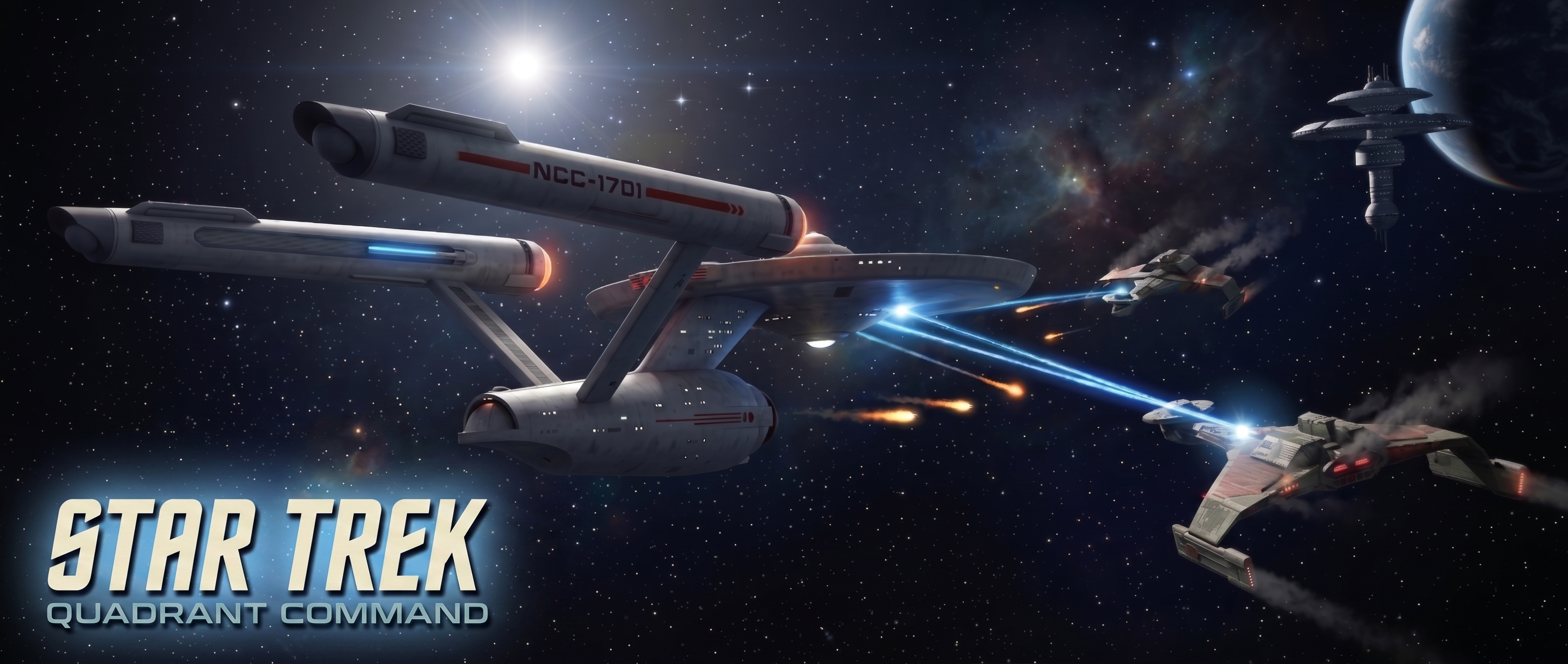
Today, this project honors that rich archival history while vaulting the classic experience into the modern era. While maintaining the foundational 8x8 tactical framework and the nostalgic charm of traditional text-based prose, this web-based expansion brings the galaxy to life with dynamic visual animations. The void of space is no longer just empty coordinates; commanders must now navigate treacherous galactic hazards, plotting courses around sensor-blinding nebulae, ion storms, subspace anomalies, and black holes.
▶ A New Mission Profile
The mission profile has also evolved far beyond simple seek-and-destroy. Captains will face multiple enemy factions, each driven by unique AI logic that requires distinct strategic counters. To survive these new threats, the tactical suite has been entirely overhauled to feature expanded weaponry, granular shield control, and energy regeneration mechanics. Whether you are a green cadet or a seasoned fleet admiral, the experience scales to your skill with five distinct difficulty levels. Combined with high-stakes Starbase and freighter rescue operations, this modernized version bridges the gap between Mayfield’s original teletype vision and the boundless, immersive potential of modern web gaming.
Reimagined for the web by JOHN PATUTO
LIVE LONG AND PROSPER 🖖