

|
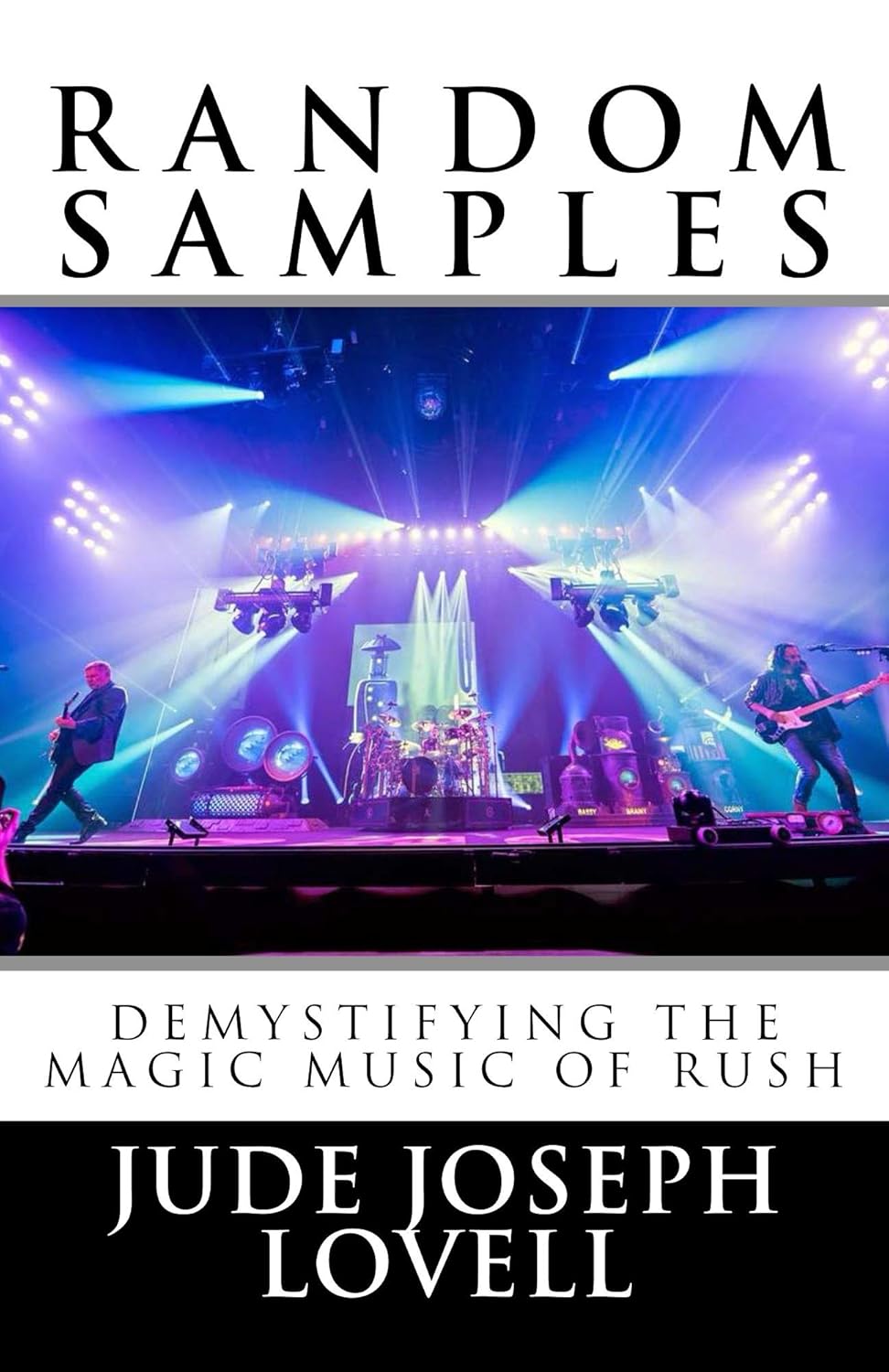
RANDOM SAMPLESby Jude Joseph Lovell
|
WHY IS RUSH HERE? BECAUSE THEY'RE HERE! As one well-known rocker put it in a recent documentary about the legendary Canadian band, "somebody has to explain." In RANDOM SAMPLES, writer Jude Joseph Lovell volunteers his services.
What Rush has achieved is practically miraculous: over four decades of popular success without a single line-up change or public spat; 24 gold and 13 platinum records; over 40 million albums sold worldwide; appointment to the Order of Canada and induction into the Rock n' Roll Hall of Fame; incalculable influence over an entire generation of musicians and artists.
This compelling book focuses mainly on three Rush albums from different eras - none of which are considered canonical - and explores how each record informed the writer as he developed from a bookish youth to a grown man with family responsibilities and wild literary ambitions. In the process, intriguing discoveries are made about the role of music and creativity; the arduous process of finding and then trusting in one's own voice; the necessity of ignoring detractors; and the enduring power of friendship - and even love. RANDOM SAMPLES will stand as both a tribute to a great rock n' roll band and a thoughtful examination of how art adds clarity and meaning to our complicated lives.
CHRIS M. BARLOW
long may he rock
CONTENTS
introduction: FINDING MY WAY
part one: HOLDING ON TO YESTERDAYS
part two: ELEVATE ME
part three: IN THE FULLNESS OF TIME
epilogue: HOLD THE ONE YOU NEED
NOTES
ACKNOWLEDGMENTS
part one
FINDING MY WAY
MY BIG BROTHER LUKE was the first one of my siblings to acquire his own stereo. He
picked it up one day with my father from Sears or Arthur’s or some New Jersey department store, probably with his own money saved through delivering newspapers. He
would have been in 8th or 9th grade, which places us in the early 1980s - ‘81 or possibly
*82. Iremember the two of them struggling to set the clunky thing up on a shelving/desk
unit in Luke’s bedroom, which he also had to himself, even though there were six kids in
the house. No one could touch the oldest brother. He was top dog. We caught the scraps
from his table - if we were lucky.
My two other brothers and I - Andrew, the kid brother, and John, my identical twin - watched them setting it up from the doorjamb, through a poisonous mist of
vitriol and envy. We were not permitted to enter under any imaginable circumstance. I
don’t remember my big sister or my baby sister caring much about that. But John and I,
around 10 or 11 at the time, certainly did.
The stereo unit Luke bought had two big speakers that looked like cinder
blocks, a turntable (of course), a big radio dial, and lots of wires. This was long enough
ago for it to have an eight-track receptacle as well as a single cassette deck. We gaped at
the whole rig like it was a red Trans Am parked in our driveway.
Not too long after, my brother holed up in that room and pretty much
stayed there until he left for college in 1986.
Within days after he got that stereo, Luke had what seemed a full collection
of LPs. To this day I am not sure how he got them. I know he did not buy them all. He
must have gotten them from a friend. I know at least one of his buddies at the time was a
massive music buff, and was particularly obsessed with The Beatles.
My theory is that this guy, and maybe one or two other dudes Luke was
friendly with, gave him some of their own collections, perhaps the ones they didn’t want, so that he could start his own. There were something like 40 or 50 of them, filling up the
lower shelf of the desk/shelving apparatus, one that seemed to be designed specifically
for holding vinyl records.
The collection wasn’t exactly throw-away stuff, either. There were numerous records by Billy Joel, Bruce Springsteen (of course - this was New Jersey), Led Zeppelin, The Who, early U2, Iron Butterfly, Squeeze, Talking Heads, etc. Many of these were
already considered classics in the 80s. He didn’t even listen to all of them. Some he liked,
some he didn’t, but we knew he just thought it was cool to have a solid record collection.
It’s been said that forbidden fruit is the most appealing - or something like
that. To our minds, at least mine and my brother John’s, Luke was cool and we were not -
a narrative that if Luke did not create on his own, he also did not discourage. We wanted
to be like him. But we had no stereo, and certainly did not have our own records. Getting
them into our house at all was a challenge in itself, as we'll see a little later.
Whenever Luke went out - which seems frequent in my memory - we
would sneak into the hallowed upper chamber and flip through those records. Occasionally, not often, we would have the audacity to slip one out of its inner sleeve and lay it on
to the turntable to play at a low volume. This was definitely a two-man job. One brother
had to be posted on lookout in the cramped dormer where Luke’s one bedroom window
was located, conveniently overlooking the driveway. That way when somebody dropped
him off, the lookout could holler “ABORT!” and we'd scramble to get the hell out of there,
while attempting to leave everything the way we’d found it.
At the time, this seemed quite risky, but we got a charge out of the danger. You
had to be careful: if you broke the needle on his record player while hastily abandoning
the mission, you were more or less cast adrift and floating down shit's creek, sans paddle.
Begging the reader’s forgiveness for all this pre-amble, which I admit is
amusing to the author to exhume from the rubble of the Reagan years, here is my point:
this, as far as I can remember, is how I discovered the music and the musicians who are
the focus of this narrative. That would be the Canadian rock trio and Rock n’ Roll Hall of
Fame honorees Rush, whom at this writing have just concluded a triumphant 40th Anniversary Tour across North America.
They’ve said it might be their last, at least of this scope. I’m here to pay
tribute to this great band, if so. For it’s been one hell of a phenomenal ride.
Luke had several Rush records in that collection. He never listened to them, and indeed
would become one of those people that don’t “get” Rush and never quite embraced them
- and there are plenty of those, including - I don’t know - maybe 90% of the entire female population born over the last five decades? This is a phenomenon that has already
been pointed out in many other places, most amusingly perhaps in the outstanding (and
highly successful) 2010 documentary Rush: Beyond the Lighted Stage - which I made sure
I saw, by the way, on the big screen during a one-day airing of the film that occurred in
my area that year.
Nope, Luke wasn’t interested in Rush. But, obviously, they did not show up
in his record collection for him. They were placed in there by the hand of God - or perhaps
fate or destiny if I do not wish to be too cavalier - for John and me to discover. And that’s
what we did.
Now, I should state that I almost certainly had heard their music previously, or I
would have skipped over their records while thumbing through the collection. This must have been in the year 1982, because I can remember seeing the album Signals on the
shelf, which came out that year. Who can forget the cover, with the spotted Dalmatian
and the candy-apple red fire hydrant? I could have been hearing the song “Subdivisions”
or maybe “New World Man” on the local New York City rock radio stations we listened to
heavily at that time.
More likely, though, is that I was a fan of the one song that all Rush fans
who are old enough can remember hearing everywhere, the one that MTV in its early
years played the live video for all the time (from one of their concert films), that is still
widely considered their signature tune. That song, of course, is called “Tom Sawyer”.
“Tom Sawyer”. One can say anything they like about this tune, or the band it
represents most definitively in so many people’s minds. But one thing you cannot say
about this classic rock song is that it sounds like everything - or anything - else. Because
it doesn’t. You know it, I know it. Everybody older than thirty-five knows it.
That alone is astonishing. If you do not think so, try making up your own
song or work of art that doesn’t sound like or look like one created by anyone else in the
world. I wish you luck.
“Tom Sawyer” is the first track on Rush’s famous 1981 album Moving Pictures,
which is one of the greatest rock records ever recorded. It remains Rush’s best known
work and is considered by most of the critical establishment - which treated the band
and their fan base primarily with condescension for the first 35 years or so of Rush’s existence - to be the pinnacle of their career. But even though Rush fans have ample cause
to disavow these same critics - there is a natural disinclination to reject the idea that our
favorite artists’ best work was made more than three decades ago - if we look at it without emotion, we might concede that this broadly-accepted convention has at least some
legitimacy.
The record has only seven songs, but every one of them is spectacular. We
have already touched on “Tom Sawyer”, which remains a staple of classic rock worldwide
to this day, instantly recognizable as belonging only to Rush. The album contains another hit, “Limelight”, also a universally revered Rush song and arguably one of the most
profound rock statements ever set to music about dealing with the vagaries of celebrity
(one of Rush’s best known lyrics comes from “Limelight”: “I can’t pretend a stranger/Is a
long-awaited friend”).
Moving Pictures further includes what I would argue is the single greatest rock n’
roll instrumental ever recorded, by many horse lengths: “YYZ”. This song, and Rush’s instrumentals on the whole, will be discussed further in Part Two of this book.
All of this is merely on the first side of Moving Pictures.
This, of course, hearkens to a time when records had sides. That is, when records
were, well, records - 12” discs of black vinyl that you had to handle with your palms so
that you didn’t smudge or scratch them, causing the player’s delicate needle to skip out of
the record’s grooves. The kind you found in a paper sleeve stuffed within a slightly larger
cardboard sleeve - the latter depicting the cover art on the front and often the track list
and/or a picture of the artist on the back; the former often containing the lyrics to the entire album in small print so you could follow along.
While I had heard their hits of the time on the radio here and there and seen a few
poorly-lit video clips of the three men in Rush playing in a live context on MTV (which
my parents deplored, and was only rarely permitted to be on in my house), it was flipping
through these records in my brother’s room that gave me my first real familiarity with a band that would make such a tremendous impact on my life both in terms of entertainment and even in my own artistic development. The records my brother had in his cache
also included Fly By Night (1975), A Farewell to Kings (1977), Permanent Waves (1980),
Exit...Stage Left (1981), and Signals.
But the two I remember by far the most vividly over thirty years later are Moving
Pictures and 2112 (1976), both of which are legendary rock albums and are seen as genuine classics even by Rush's most ardent critics. There is no disputing that both of these
albums had a major impact on rock history.
I knew little about either at the time. I do remember in a visceral way the
aural experience of dropping the actual record of Moving Pictures onto my brother’s turn
table in my boldest moments, gently lifting up the arm, placing that fragile needle on
the whorling blackness of the vinyl beneath, and listening in anticipation to the slightly
magical crackling of the needle scratching the plastic before it would catch the groove.
Then, that unforgettable guitar chord and mini-Moog synthesizer collision announced
“Tom Sawyer”, exploding off the angled ceiling and wafer-thin walls of that little bedroom out in the Jersey suburbs.
I didn’t know much at all about rock music then. I didn’t know anything
about the three youthful men from Canada who were responsible for these records. I
couldn't really grasp the lyrics either:
A modern day warrior
Mean, mean stride
Today’s Tom Sawyer
Mean, mean pride
I couldn’t make much of the mysterious cover art of Moving Pictures, other than the fact
that what it depicted was literal, i.e., workers moving framed pictures. And I definitely
could not make heads or tails of anything I saw or heard on 2112, Rush's spacey, audacious concept album, released when I was only five years old.
What I could see, even that early, was that Rush was different. They were unique.
They never seemed to do the same thing twice. They stretched themselves creatively.
And they quite obviously did not give two craps about convention or “fitting in’. Nobody
who had come up with a concept as nutty as 2112 - or who looked as ridiculous as those
three young men did on the back of that record - could have cared too much about what
critics, authorities, executives, fans, or anybody had to say.
That was cool, I decided. That, even at my tender age, I could latch on to. And I did.
part two
HOLDING ON TO YESTERDAYS
I remember the first three records I bought with my own money. In order. I don’t know
why, nor do! know why I cannot recall what I bought after the third one. But I like to theorize that after the third it simply didn’t matter anymore.
The first was back in 1983, and I still stand behind the selection. Eliminator, by Z.Z.
Top. I was in seventh grade at the time and MTV was gaining an immense head of steam,
coinciding with the rise of cable television, which offered such novelties as 24-hour news
coverage and something called Home Box Office, better known today as HBO.
Z.Z. Top is a Texas-based rock r’ roll trio who reached a modicum of success
in the 1970s and early 1980s with minor hits such as “Tush”, “Cheap Sunglasses”, and
the ever-popular “Jesus Just Left Chicago”. Someone handling them at a certain point
decided that they ought to shoot a couple of music videos and get the band on top of the
gigantic wave that MTV was swelling into.
Whoever had that idea was a genius, because in 1983 you couldn’t watch MTV for
twenty minutes without seeing the video for “Gimme All Your Lovin”, “Sharp Dressed
Man”, or “Legs”, all from Eliminator. You also couldn't forget the chest-length beards
sported by guitarist and vocalist Billy Gibbons and bass player Dusty Hill, or the black
sunglasses perpetually worn by all three members.
All I knew was that I wanted the record. But to this day I can’t remember
exactly where and when I bought it. I do remember getting it home, tearing off the cellophane, and laying the disc on the horrible-sounding, toy-like record player we kept deep
in the annals of our dank, unfinished basement. The drumbeat that kicks off the first
track, “Gimme All Your Lovin”, still hits me in the exact same way today as it did the first
time I played it all those years ago. That song, more than most others, is a three-minute
sonic time machine for me.
Record #2 was my first heavy metal album - certainly not the last. My tastes were
trending this way overall, something that certainly did not meet my parents’ approval.
The record was Judas Priest’s Screaming for Vengeance, an album I wanted based on the
title alone, although what sense of injustice it tapped into inside me personally is a little
difficult to discern from the considerable distance of thirty years’ time. But any teenager
who was drifting towards heavy metal in the 1980s would have heard Priest’s classic
anti-establishment screed “You Got Another Thing Comin”. Once J did, I wanted more of
wherever that “thing” came from. So much so that I rode a ten-speed bike six or seven
miles through the rain one day to buy the album in a Pathmark grocery store in Gilette,
New Jersey. I then carried it all the way back home in a rupturing brown paper bag while
trying to steer the bicycle and avoid terminating my short, hard-rockin’ existence.
Album #3? Grace Under Pressure, by Rush.
Rush has never been considered heavy metal. “Progressive rock” is the term
most people use, whatever that really means. Furthermore, in the first half of the 1980s
they were delving into the one gray zone on the musical map from which most hard
rock fans agreed there was no returning from with your credibility intact. That would
be the Land of the Synthesizers. Keyboards were absolute deal-breakers to metal fans, by
and large, in the 80s. That shit was for girl bands like Duran Duran or Frankie Goes to
Hollywood.
Putting a heavy synthesizer in your rock n’ roll song was an instant declaration of a corporate sell-out, and therefore anti-metal in every respect. As Exhibit A from
somewhere around this time, I submit “Jump” by Van Halen. Needless to say it was a
big hit and sold a lot of records for that band. But it exiled them forever from the mountainous regions where the true hard rock fans circle the fire with their brethren and wargame global domination.
Yet there will always be those artists for whom established conventions never quite
apply. Rush had used the mini-Moog synthesizer to create an unforgettable opening to
their signature cut, “Tom Sawyer”, after all - and almost no rock song in history rocks the
way that one does. Then they dove into keyboards headlong on 1982's Signals - the same
year that the entirely keyboard-less Screaming For Vengeance came out - and produced the
single “Subdivisions”, a song so synth-heavy that I’m still not sure Alex Lifeson, Rush’s
guitarist, even played on it, except for a brief solo.
Somehow violating the taboos of the transforming musical scene of the 1980s
didn’t make a difference with Rush. Whatever they did, they managed to make it rock.
“Subdivisions” is drenched in keyboards - as is most of Signals - and yet it still rattles
your inner framework, thanks in large part to drummer Neil Peart’s hammering fills and
Geddy Lee’s equally aggressive bass playing (Lee is also Rush’s singer). When you had
those two at the bottom, it didn’t matter what you draped over the top. Rush’s rhythm
section would put on an even more extraordinary clinic in the Signals cut “Digital Man”,
which contains a blistering bass-and-drums “dialogue” that stuns freshly to this day.
After Signals, the keyboards became permanent in Rush's arsenal, although
they would later be (correctly) relegated to more of a supporting role to the band’s core
instruments. In early 1984 the first single from Rush’s forthcoming Grace Under Pressure
album dropped, and a video began airing heavily on MTV. It was called “Distant Early
Warning”, and as soon as I heard it once, I was permanently hooked.
Most fans probably would not include this cut in their Top 20 of Rush’s
songs, but for me it was a game-changer, and remains near the pinnacle of my personal
list. It’s of a piece with “Tom Sawyer” - I hope I don’t lose the die hards by saying as much
- in terms of its thoroughly unique sound and its life-changing impact on yours truly.
What I did not realize, nor would necessarily have appreciated at the time, was
that “Distant Early Warning” was the first indication of a seismic shift in Rush’s method
of making records. Grace was the first record not produced by their longtime collaborator Terry Brown since 1975's Fly By Night, Rush's second studio album. The band had
an amicable parting of the ways with Brown following Signals in order to “mix up” their
creative approach, and ultimately settled on producer Peter Henderson for their next
recording.
Of course, I had no notion of the ramifications of this change in terms of how Rush
made their newest album, from a musical or technical point of view. I still don’t. What
I did know, after hearing the opening guitar chords and bass of “Distant Early Warning”
at the tender age of thirteen, was that the song had a visceral impact on my rather impressionable and malleable musical palate. It is something I still hear and feel to this day
when I spin up the studio version, which kicks off the Grace Under Pressure album.
It was not until the year 1990, at nineteen years old, that I would finally experience
Rush perform live for the first time at Riverfront Coliseum in Cincinnati, Ohio. I still
remember that the third song in the set that night was “Distant Early Warning”, even
though it was twenty-five years ago. I also recall my elation over seeing and hearing them
play a song from Grace Under Pressure that meant so much to me.
It is difficult to articulate in prose the effect that “Distant Early Warning” had on me
in 1984. Musically, it was bone-rattling. It shook me to the core in the best possible way.
When I go back and consider Rush’s music from the 1980s, the great majority of it I truly
love and admire. But not all of it seems very balanced, in hindsight. I’ve already pointed
out that Signals suffers indisputably from an overreaction to the prominence of synthesizers in the New Wave era.
The album that followed Grace Under Pressure, 1985's Power Windows, is ebullient
and powerful, and contains one of the most blistering full-album bass performances
Geddy Lee ever laid down. But it definitely suffers from what I would call over-production. There are too many sonic bells and whistles thrown in to the mix, and the keyboards
are overpowering at times. Just listen to the otherwise potent “The Big Money” or “Grand
Designs” on headphones and you'll understand.
Grace, though its sound overall is dated today as it must be, achieved a wonderful
balance between guitar, bass, drums, and synthesizers that is often overlooked in assessments of Rush's work from this era. Here is one place where the band and their producer
actually did achieve a good amalgamation of their various sonic weapons.
Conventional wisdom, fueled by numerous interviews over the years, has established that Alex Lifeson was frustrated with the ultimate product of the Signals album
because his guitar playing was basically drowned out of the final mix. This problem
was resolved definitively on Grace Under Pressure from its first massive chord of electric
guitar. It barrels into the listener like a tsunami and pushes straight through the entire record. Grace has a unique sound that is not quite matched by any other Rush record
before or since - marked by a bracing urgency, a klaxon-like ability to pierce through the
air, as though the music itself is the forewarning the first track suggests.
Lifeson in particular has many glorious lead guitar moments throughout Grace, including mesmerizing solos in “Kid Gloves” and “Between the Wheels” (the former he has
cited as one of his personal favorites) and the striking vocals/guitar call-and-response
motif in “Afterimage,” a moving song about grief that Peart (also Rush’s lyricist) wrote
after losing a close friend. Yet this record, and Lifeson’s muscular performance, is almost
more noteworthy for its potent rhythm guitar, unforgettably exhibited in particular on
the first three cuts of this 8-song album. The holocaust epic “Red Sector A” - which at
first sounds like a Red Dawn-like sci-fi nerdfest typical of 80s popular culture, but gains
considerable gravity when one learns it was inspired by Lee’s parents, Polish Jews who
both survived the actual Nazi holocaust - would lose most of its visceral impact without
Lifeson’s shock-wave chord progressions.
Random Samples: Demystifying the Magic Music of Rush