


|
Geddy Lee's
|
This book is dedicated with love to the amazing N.Y., without whose steadfast encouragement
and extreme level of nerd tolerance it would not have been possible for me to go
down, down, down the rabbit hole once again . . .
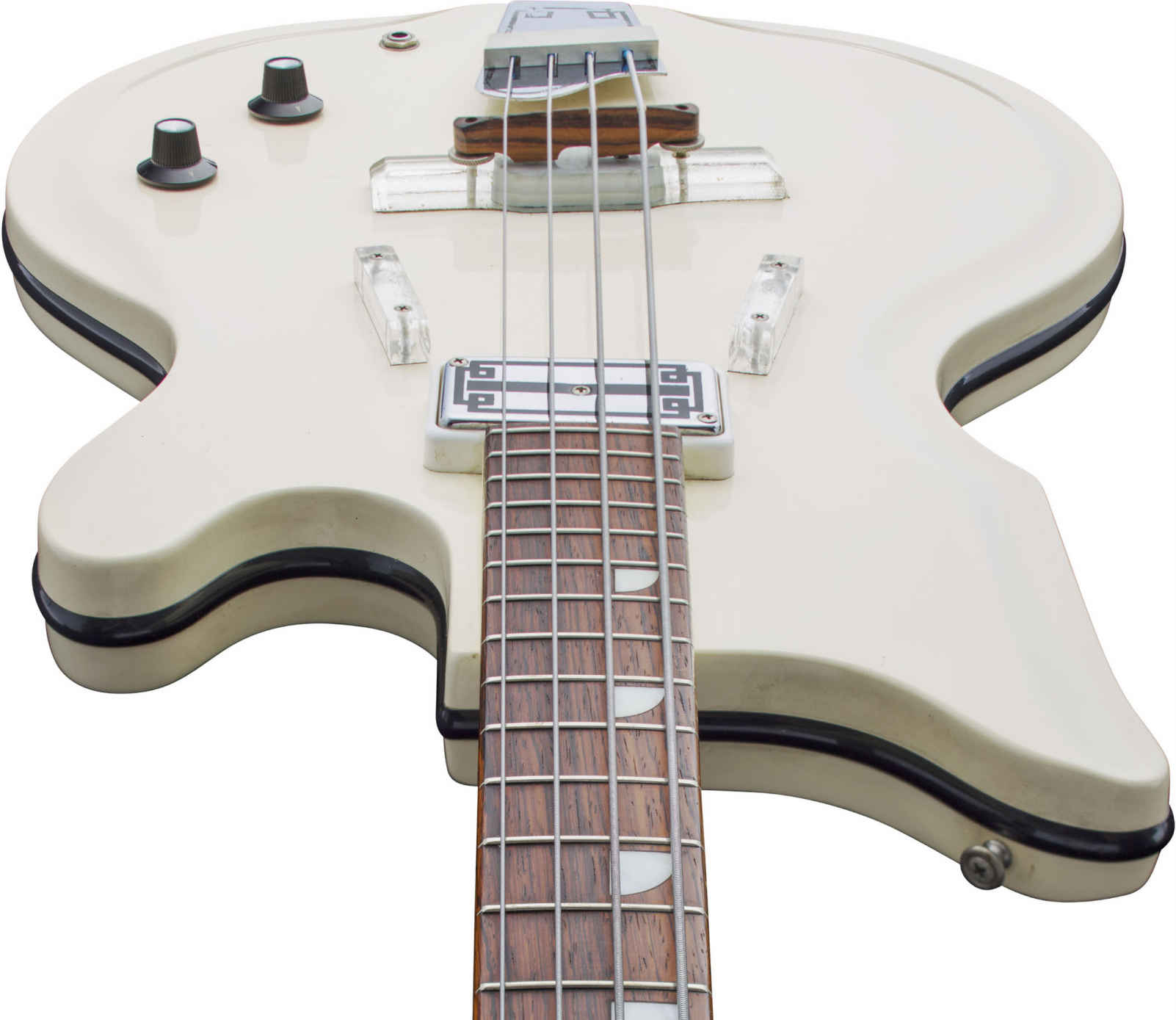
Click Any Image to Enlarge
CONTENTS
Backword by Alex Lifeson
Introduction:
Falling Down the Rabbit Hole
Chapter One:
Fender
Fender Precision Bass
Interview with Jeff Tweedy
Fender Jazz Bass
Interview with Alan Rogan
Fender Bass: Outliers and Oddities
Interview with John Paul Jones
Chapter Two:
Gibson and Epiphone
A Brief History of Gibson
Gibson Short Scale Solid Body
Epiphone Short Scale Solid Body
Gibson-Epiphone Short Scale Hollow Body
Interview with Adam Clayton
Gibson Thunderbird
Gibson Thunderbird Reverse
Gibson Thunderbird Non-Reverse
Interview with Ken Collins
Chapter Three:
Rickenbacker
Rickenbacker Solid Body
Rickenbacker Hollow Body
Interview with Robert Trujillo
Chapter Four:
Höfner
Höfner “Violin” Bass
Höfner Archtop Bass
Höfner Solid Body
Chapter Five:
Ampeg
Interview with Bill Wyman
Chapter Six:
Around the World in 80 Basses
(More or Less)
Interview with Les Claypool
Interview with Bob Daisley
Chapter Seven:
My Favorite Headaches:
Stage and Recording Gear, 1968–2018
A Kaleidoscope of Bassy Moments (and Other Historical Stuff)
Acknowledgments
About the Author
Copyright
Terry Foster
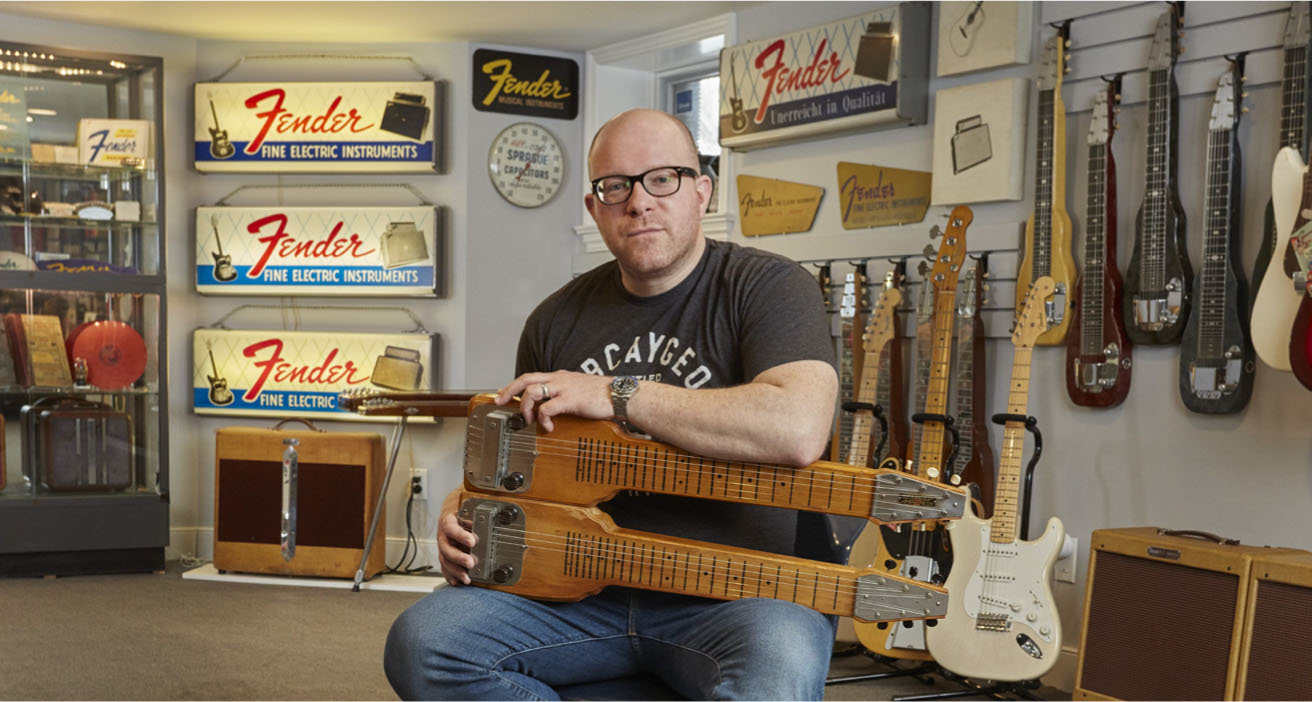
Leo Fender once said, “I don’t believe that any electric guitar improves with
age. I think that is a myth.” Was he right?
Great collections transcend the objects contained within them: they tell
stories, relay information, create meaning, and convey purpose. The
extraordinary and beautiful industrial designs thoughtfully showcased in this
book range from pristine, virtually untouched examples to those played
passionately night after night.
Years after the golden age of electric guitar manufacturing, Leo couldn’t
comprehend the desirability of the early output of his and his contemporaries’
factories. Throughout his life, he relentlessly pursued perfection through
incremental improvement. This book is a testament to the insatiable drive of
Mr. Fender and his peers.
In the early 1950s, the electrification and mass production of solid-body
guitars and basses sparked a revolution. With amplification, bands became
more efficient and mobile. Louder and smaller, guitars became an attentiongrabbing
lead instrument capable of playing to ever-larger venues. Music
changed forever. The most successful bands of every musical style toured
locally and nationally, building the DNA of modern music. From honkytonks
to hayrides, ballrooms to basements, garages to stadiums, high schools, and
clubs, these stringed instruments evoked joy, passion, hysteria, angst, discord,
and rebellion. The intimate relationship musicians forged with these tools
helped write the soundtrack of the twentieth century.
Mr. Fender was wrong: electric guitars do get better with age. The
presence of those who played them before us forever exists within these
instruments. They are an extension of our collective musical identity and
echoes of the past. Vintage guitar collections of this importance and
magnitude rarely rest in the hands of a musician as accomplished as Geddy
Lee. Geddy’s collection represents every important popular musical genre,
every tone in the bass palette, and is, quite simply, one of the finest of its kind
in the world.
Co-author of Fender: The Golden Age 1946–1970
Alex Lifeson

Geddy Lee is still my best friend. That says a lot about a relationship that has
lasted more than half a century. We’ve shared many remarkable experiences
in that time, both as bandmates and as buddies, but the thickest glue that
bonds us has been our common love of music and musicianship . . . that, and
all his great wine I helped him drink.
For forty-six years we wrote, recorded, and performed some of the most
challenging music we could think of, and I’d often shake my head and smile
at the crazy-cool bass parts Geddy would come up with. They were even
better than the bass parts I thought I could write—mostly! They always
seemed to be just the right combination of smarts and feel that allowed both
Neil and me to explore our own arrangements more freely, especially the
amazing drum parts that I also wrote but, of course, never got used.
Now he’s presented his collection of basses in such a thoughtful and
elegant manner that, I must say, looking at the photographs makes me want to
become a bass player. Whew, shake it off, Al, shake it off!
I’ve been on the other side of the stage while Geddy’s played many of
these bass guitars, and his passion and love for them were evident to me
whenever I saw his huge grin. I know how hard he worked on this gorgeous
book—I’ve hardly seen the guy for the past year, and I’m getting rather
thirsty, but I know what it means to him to be the custodian of all those
incredible instruments with their colorful histories. He didn’t do this for the
big bucks and chicks like I did; he did it because he loves those four-stringed
wonders that have given him so much joy throughout his life . . . and mine.
FALLING DOWN THE RABBIT HOLE
I suppose it was during the spring of 2012 that the notion of acquiring a
vintage bass guitar first lodged in my mind. We had just started gearing up
rehearsals for the Clockwork Angels Tour when I was approached by a music
store with an offer of an instrument swap. They were looking for one of my
stage-used basses to beef up their own “hall of fame” and tried to tempt me
with a mid-1950s Fender Precision in return. At first blush, I wasn’t
interested. I wasn’t a collector (of instruments, at least) and would certainly
never, ever part with any of my main instruments—certainly not the 1973
Rickenbacker 4001 or my current Number One, the 1972 Fender Jazz.
Still, it sparked a series of discussions about vintage instruments with my
trusted bass technician, John “Skully” McIntosh, during which I not only
discovered how passionate and knowledgeable he was on the subject, but also
how little I actually knew about the history of the instrument I’d been
associated with for more than forty years.
So I started reading up on Leo Fender and the early years of the Fender
electric bass. What a leap those instruments represented for the musical
technology of the day, and what it must have meant to players back then to
go from playing a stand-up all their lives to suddenly having a fretted
instrument in their hands. Then I investigated the history behind
Rickenbacker, Gibson, Höfner, and on and on, getting deeper and deeper into
the story of my main monkey business. The genealogy of these various
brands had become, quite suddenly, fascinating to me. And as anyone with
the collector’s gene will tell you, “fascinating” can be a dangerous word. . . .
Allow me to take a moment here to explain something key to my
personality. Once I turn my gaze to a thing with any degree of interest, I
become curious, and feel compelled to research it. Curiosity turns into
“fascination,” which begets even deeper “engagement,” and then, uh-oh, it’s
a full-blown obsession. And I’m, like, Really? Again?
This trait of mine started at an early age with a typically nerdy pursuit . . .
wait for it . . . stamp collecting! (Glad I got that off my chest.) But then, and
not a moment too soon, I discovered music and began to amass a mountain of
vinyl. I started with the West Coast sounds of the Beach Boys and Jefferson
Airplane, then turned to Brit rockers like the Yardbirds and the Who, and
then the more obscure prog bands from the 1970s. (Van der Graaf Generator,
anyone?) Lucky for me, I suppose, all that listening got me obsessed with
figuring out songs—first on guitar and then the bass, spending countless
hours in my room, jamming along with all those fabulous records until I
could mimic my fave bass players.
The “collector’s gene” didn’t surface again until much later in life, when I
was a touring musician with lots of idle time on my hands in the many
different cities of the world I was lucky enough to see. I first became a
devoted student of the game of baseball, watching the Cubs on WGN-TV
every afternoon, as I groggily awoke around midday, after driving all night
from the last gig. Then, having access to so many local museums and
galleries in those cities, I got into photography, which led me to modern art
and architecture, and eventually fine wine and food. I found myself spending
my free afternoons (a working musician should never get up before noon) in
each town’s art institutions, and my evenings in the coolest local restaurants
with the most interesting wine lists I could find. And if I had more than a few
days off, I would scurry off to the nearest wine region—soaking it all up, so
to speak. It was education by complete and total immersion in whatever had
caught my “curiosity.” As the great and wise pianist and raconteur Oscar
Levant once said, “So little time . . . so little to do.” Or something like that.
In the 1980s, my love of watching baseball turned into collecting baseball
ephemera. For me, that was a way of learning about not just the history of the
game but also the history of the US itself from a variety of social
perspectives. Similarly, by the 1990s, my love of wine was taking my family
and me all over Europe on our holidays, building a collection of juice while
learning about the histories and cultures of the places it came from. And so, if
these obsessions had become doorways for me to living histories and glorious
pasts, I suppose it’s not surprising that sooner or later I’d dive down the
proverbial rabbit hole into the world of vintage bass guitars.
Skully and I first decided we would research a few of the classic basses
played by those musicians I’d admired most as a teen; we’d put together a
“modest” collection that represented my rumbly beginnings. But the more we
looked, the more I learned, and the more I learned, the more I acquired. I
started with Fenders, and in particular Jazz Basses, but eventually got hooked
on instruments I had never played before. They were to me irresistibly
intriguing.
I’d always been very focused on crafting a sound of my own, and I shied
away from instruments I feared might lead me in the wrong direction. That
single-minded approach certainly helped me create my own bass identity, but
looking back now, I realize it may have also closed my ears and eyes a bit.
Forty-plus years later, I’m beginning to understand the craft and the people
behind the various sounds and tones of basses that were always out there and
available to me as both a player and now a collector, particularly those
instruments manufactured in the years between 1950 and 1975. I feel like I
owe it to my bass to do right by it. Silly, maybe, but collectors need all sorts
of reasons to permit themselves the indulgence of collecting.
Anyway, as I was saying, Skully and I began to scour the globe.
Gathering all the basses in one place has allowed me to examine the subtlest
changes in their evolution—aesthetic, electronic, and ergonomic—and I’ve
also been able to check out their fundamental sound. I’ve had a boatload of
fun plugging them in and playing them all (and even road-testing more than
two dozen of them), and doing so over and over, back to back, and side by
side, has allowed me a rare opportunity to get a grip on the very essence of
the bass guitar.
I began to ponder the origins of the thing. My generation’s experience of
the bass is as an instrument that enjoys equal rights. It could sit up-front,
moving the song along melodically, like James Jamerson’s part in “My Girl,”
or mesh with the drums to help create a rhythmic counterpoint, as Chris
Squire does so emphatically in “Roundabout.” But this is a somewhat
contemporary point of view. What about the role of the bass back in the day?
Well, historically, while there certainly have been concertos for the double
bass, and the instrument did enjoy a period of popularity as a solo instrument
in the 1700s (and the basses introduce the final theme in the fourth movement
in Beethoven’s Ninth Symphony), it’s fair to say that bass has literally been
second fiddle to the main event.
As music evolved (or devolved, depending on your taste), so did the
shape and the role of the bass, and plucking began to take precedence over
bowing. According to Jim Roberts, the author of How the Fender Bass
Changed the World, the great-granddad of the modern electric bass was the
sixteenth-century bass lute. Big boys like the theorbo and the chitarrone
sometimes had strings five feet long to produce superdeep notes. Evolving in
parallel was the bass viol, of the violin family, which became the contrabass
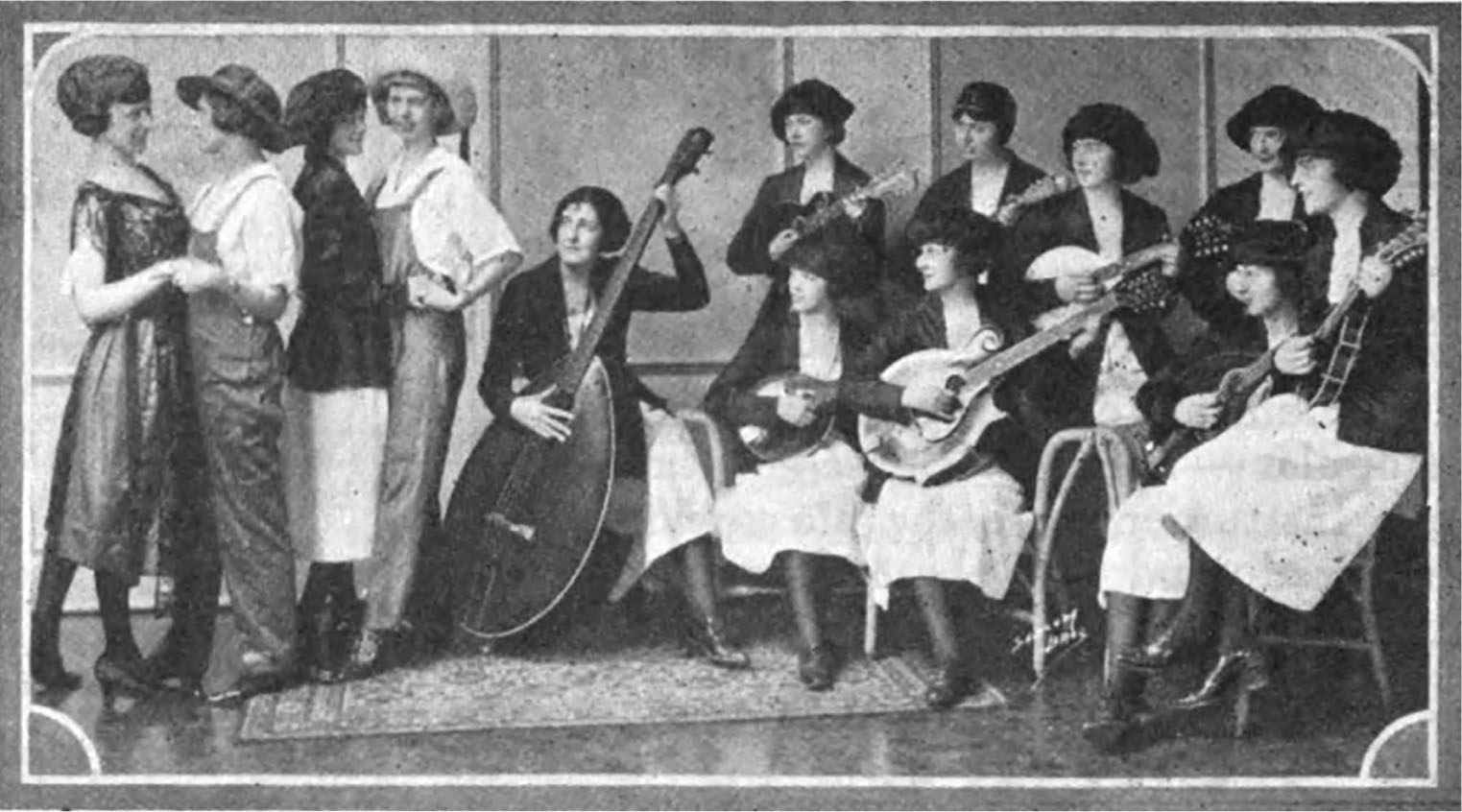
—although it was designed to be bowed. Then, in the early twentieth century,
along came the mandolin orchestra boom (yes, that was a thing) and with it
the fretted mandobass, made specifically for pluck-minded players and tuned
to E-A-D-G like a double bass, setting the stage for the modern bass guitar.
The advent of electricity fired up both musicians and inventors. Oh, the
possibilities! Telephone transmitters were being placed inside violins and
banjos, carbon-button microphones were tinkered with, everyone wanted to
get louder. Finally, in 1932, the Ro-Pat-In Corporation in Los Angeles began
commercial production of the Rickenbacher Electro A-22, a.k.a. the Frying
Pan, the first stringed instrument with a pickup. But that was a six-string; if
you were a bass player in a dance band, you must have stood at the back of
the orchestra with your double bass, wondering, “When is it my turn?”
Over the next twenty years, there were stabs at louder bass design: Dobro,
for instance, offered a bass version of its metal resonator; and the Electro-
String Instrument Corporation (as Rickenbacker was then known) created the
metal-body Electro Bass-Viol, which required its endpin to be plugged
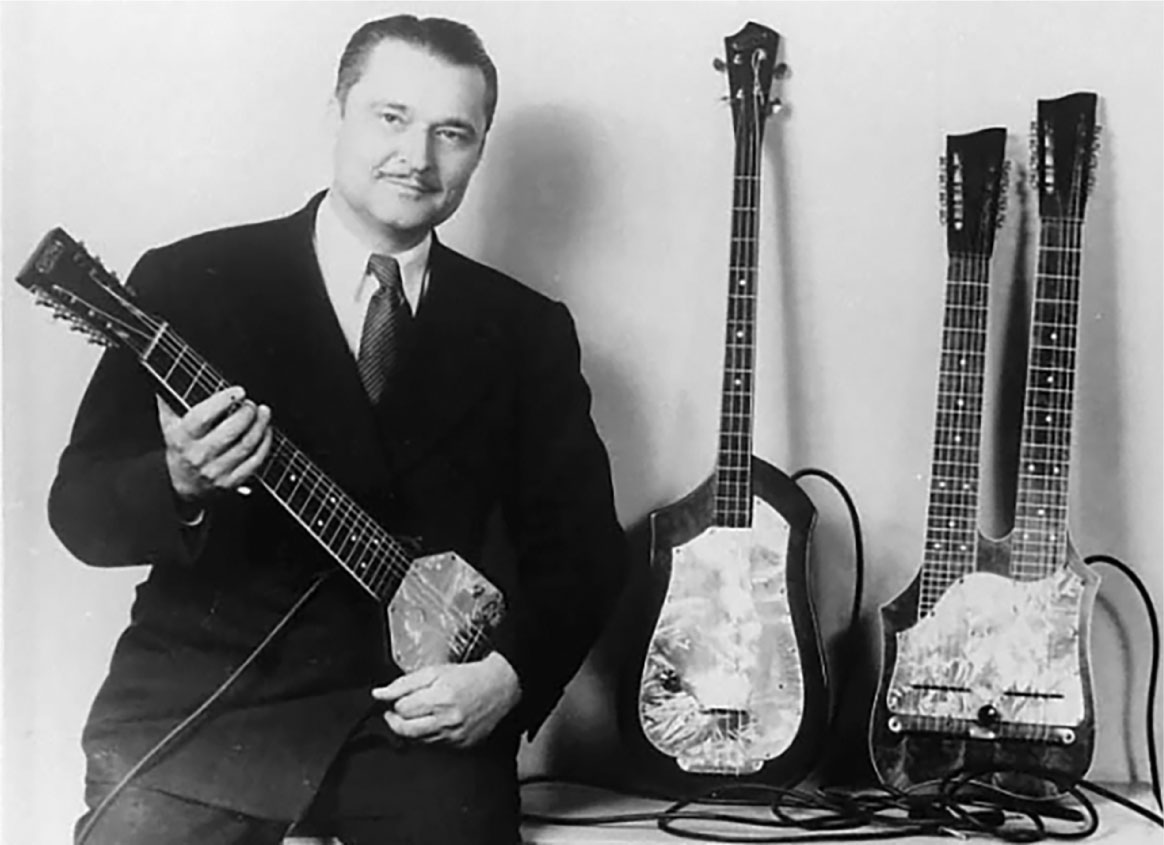
directly into the top of an amp. The earliest bona-fide solid-body electric bass
—as we’d recognize one today, played horizontally and reliant on a pickup—
was the Audiovox Model 736, designed by Seattle’s Paul Tutmarc in 1936.
He really should be popularly credited with conceiving the very first, but with
World War II and other events getting in the way, it didn’t happen for him.
So it was, in 1951, that Clarence Leonidas Fender—better known to us
guitar nerds as Leo—introduced the Precision Bass, “freeing the bass from
the doghouse,” to use his own words. And that is sort of where I come in; or
more precisely, where my collection does.
In the course of my various other pursuits, I’ve learned that the true
collector’s mind-set—and for the most part, one I share—is about condition,
condition, and, oh yes, condition, but with guitarchaeology, the condition of
an instrument tells me only half the story. Most collectors want only pristine,
untouched, and unplayed instruments that have been under beds and in
closets in suspended animation for decades; the cleaner they are, the more
valuable they are to them. I get that, but what about the instruments that have
lived a life?
What about the well-worn, smoky, sweat-soaked instruments that have
played the bars, played the high schools, paid their dues at the weddings and
the blues festivals, truly earning and showing their age spots, having not only
made a living for their owners but also given their audiences pleasure? Those
instruments have real effin’ mojo to me. They don’t necessarily have to have
been owned by the famous, just by everyday working musicians—whether
professionally or as weekend warriors, it doesn’t matter; whoever it was who
played because he or she loved to play, who wore the frets down to the
fretboard and the paint down to the undercoat while doing so. Those are the
instruments with stories to tell, not in so many words but in the way they look
and the way they feel when I pick them up to play them myself. In this era of
“relic’d” instruments—new but made to look artificially road worn—I feel
it’s important to find the real deal to give context to what that idea of playing
music really means. You can reproduce a look but not the life lived.
That being said, as usual I wanted it all: both the wall-hangers and the
players, and a bunch that fall in between—but you can’t play 250 all at once
—at least, I can’t—so why not share them with other bass geeks and
collectors with the same affliction? To quote Steven Wright, “You can’t have
everything. . . . Where would you put it?” The answer is, in this book.
The title notwithstanding, I haven’t done it all alone. From the outset, I
knew I’d need a damn fine photographer with enough experience and
creativity to snap hundreds of basses and keep them interesting, a far more
difficult task than you might imagine. Instruments often have contours,
angles, and features that defy easy translation to the page; their beauty lies in
both the macro and the micro, and above all their colors are hellishly difficult
to capture accurately—especially when you have a world of guitar geeks
(starting with myself) to please, who are extremely particular about such
details. I’m sure you will agree that Richard Sibbald has made these bass
guitars look as lush and varied as the tones that they produce.
Along this journey of discovery, I also realized there were instances in
which my or Skully’s knowledge was wanting, so I also leaned on several
discerning and experienced collectors, players, and guitar builders to make
sure we didn’t miss the key historical facts, the juiciest details, and the most
esoteric minutiae. For the generous contributions of their time, scholarship,
and good humor, I will be forever grateful.
Thirdly, wrangling words is not quite as easy for me as wrestling with
notes. Fortunately, I just happen to be good friends with a guy who not only
plays guitar and knows a hell of a lot about music, but who also encouraged
me from the beginning to dive into the project. That person is my longtime
pal, the author and journalist Daniel Richler, who’s dedicated himself
throughout this project to keeping me clear and focused and very me on the
page (without using too many f-bombs).
I know that when one gets truly engaged in a subject, it’s hard to resist
the tendency to go on a bit. So I’ve tried as best as I can not to be obnoxious
with obscure bits of information. (Fail!) Reference books and the internet
abound with that kind of detail, both right and wrong, and I’ve tried to keep it
to a minimum—but sometimes it’s irresistible. Out of consideration for the
rest of the population, we’ve created sidebars and various notes (or, as I like
to call them, “nerd bubbles”) that contain all manner of technical and
historical data, so that those of you who somehow feel content to live your
lives without such extra information may feel free to ignore any or all of them
and get down to looking at the basses.
Finally, you’ll see that there are interviews, comments, and quotes from
my fellow bassfolk spread throughout this book. I have to say, I had such a
blast visiting, grooving, and corresponding with them; I truly did not
anticipate how rich and revealing their stories would be. Some share the same
madness for collecting, some have collections that contain one-of-a-kind
historic instruments, but all of them share the same love of playing the bass
that I possess. But more contextually, these conversations shed light on the
world of rock I’ve been fortunate enough to play a part in. Apologies if your
fave bassist is not featured here as I would have loved to talk to even more,
but I simply ran out of time and pages.
I hope you enjoy the trip.
FENDER
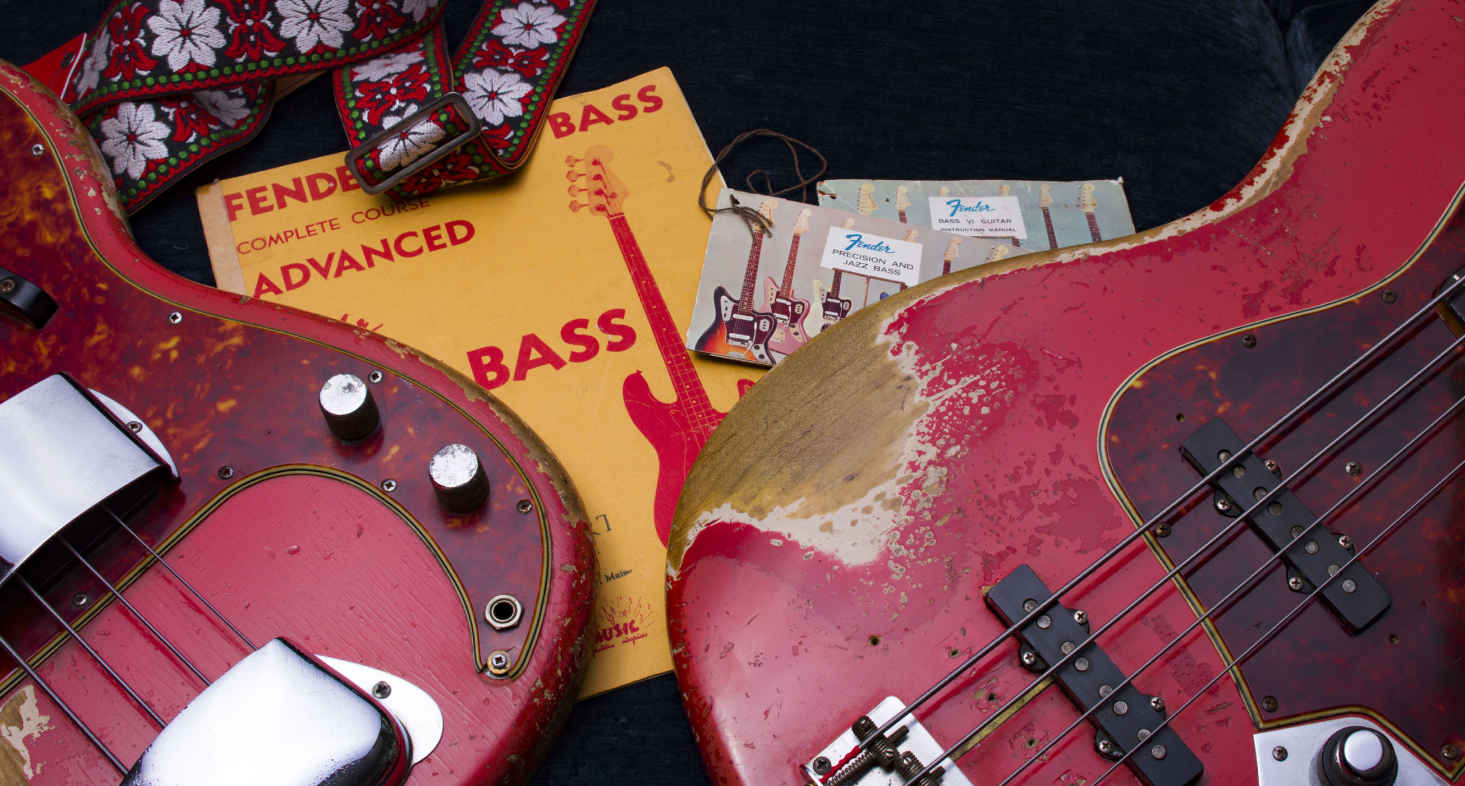
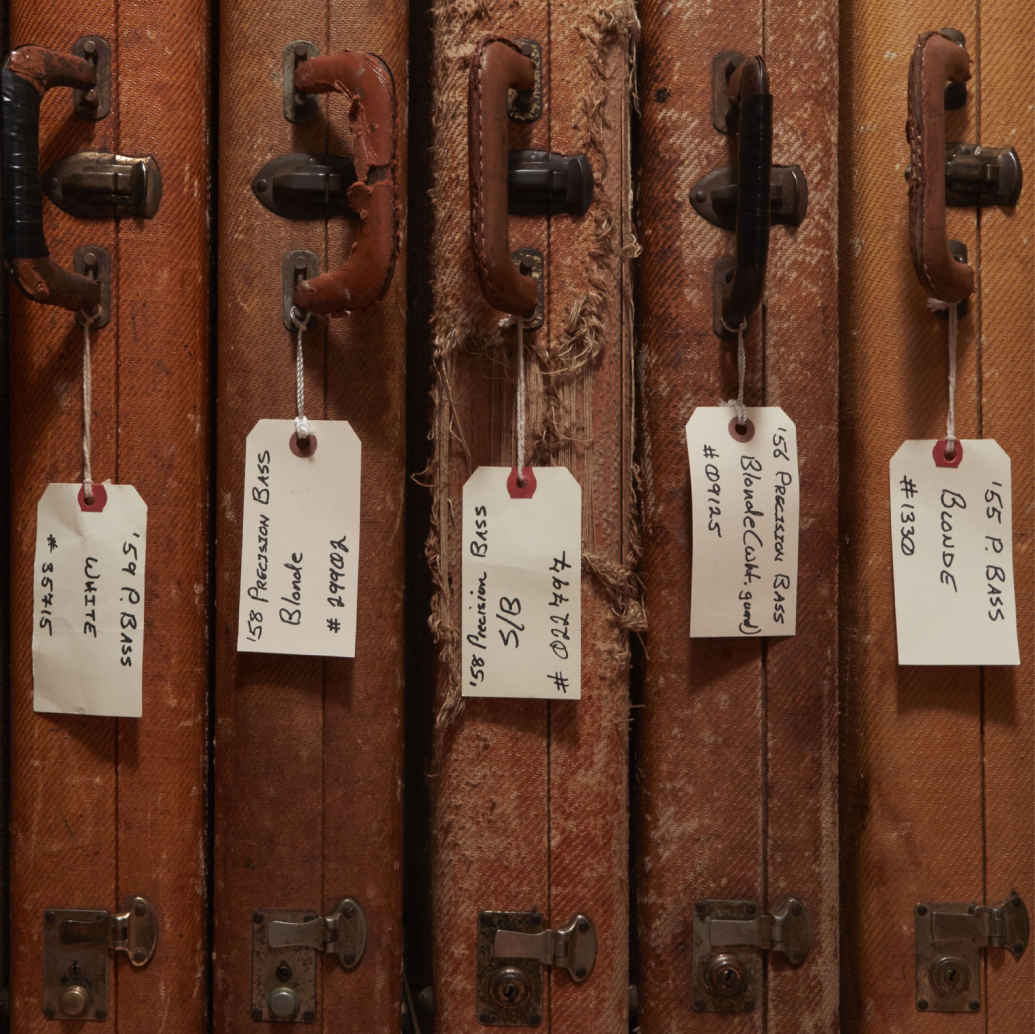
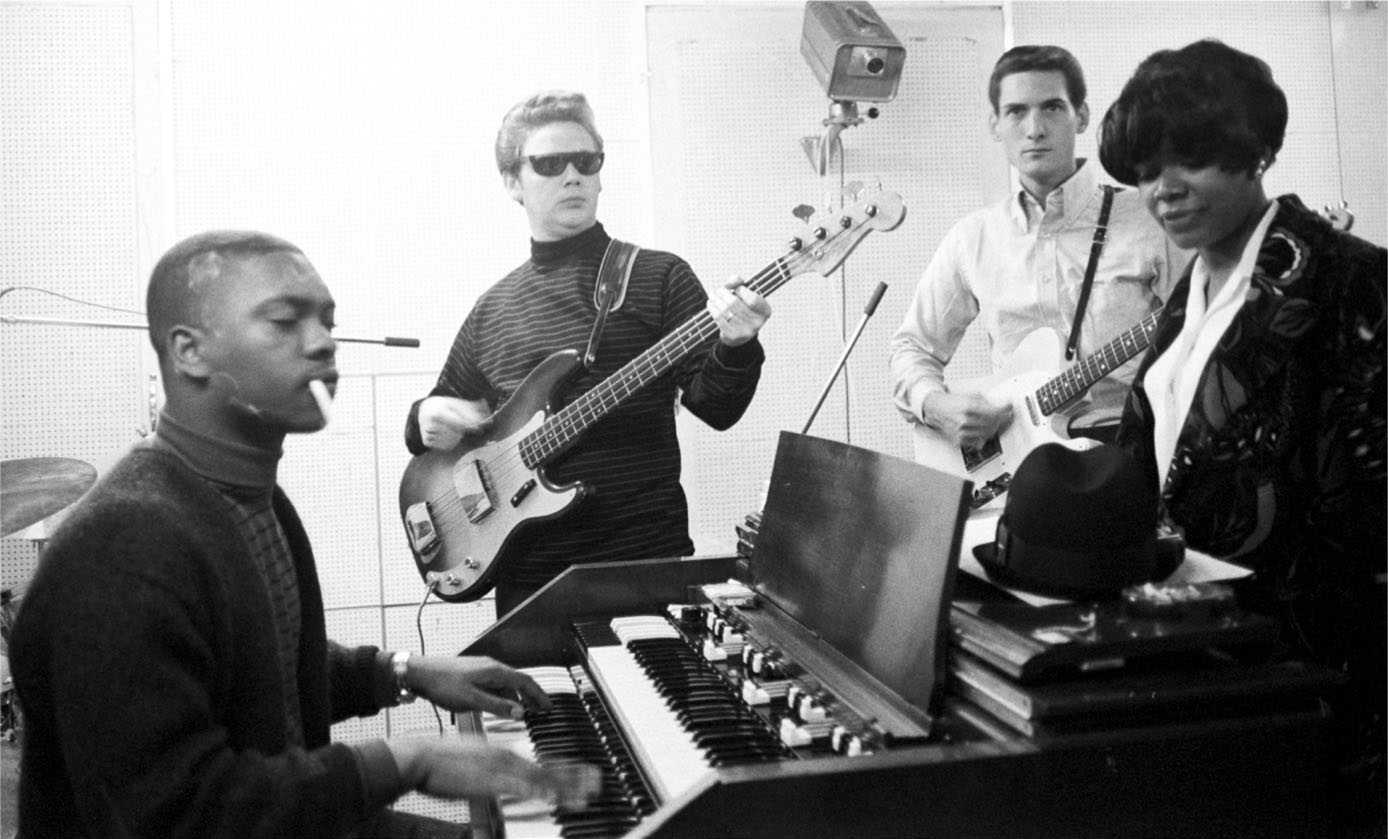
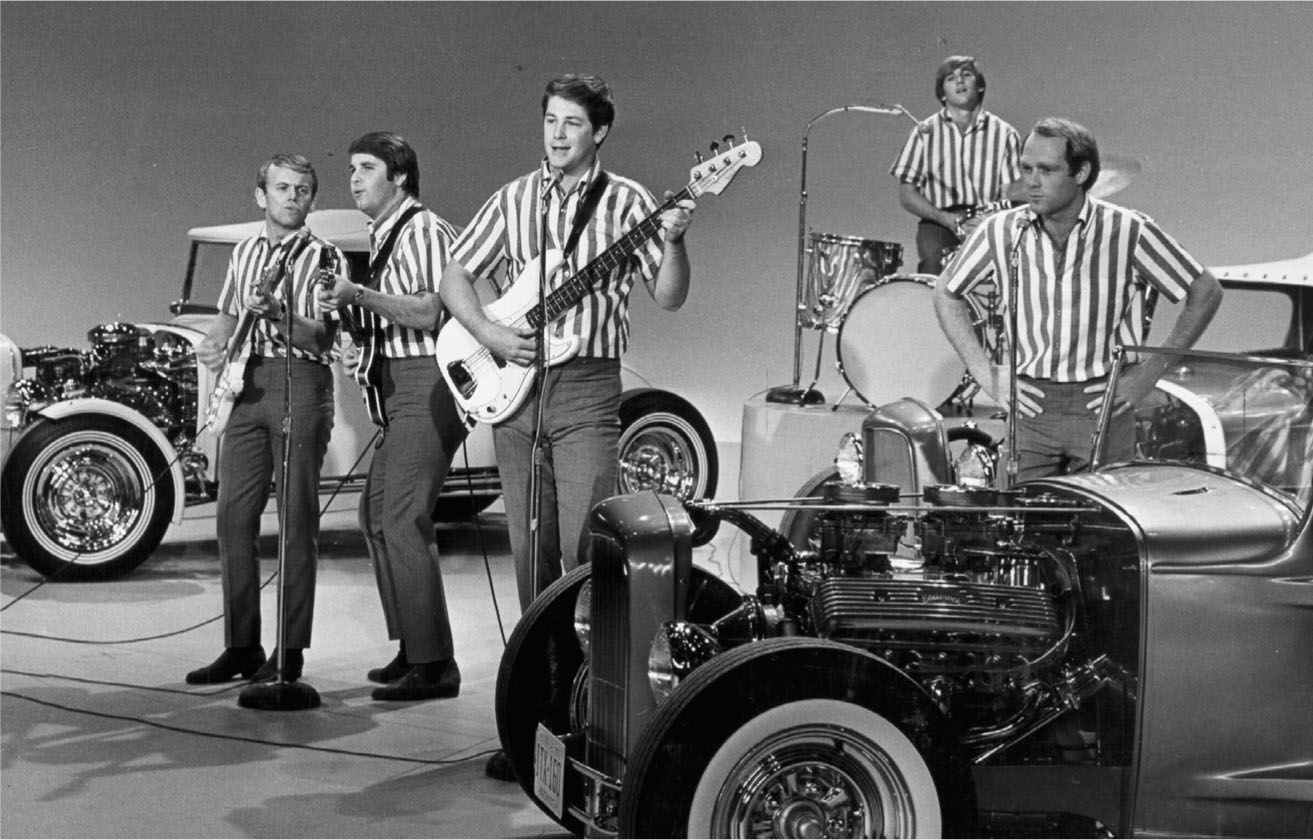
When I was boy, the radio was always on in my mother’s variety store. In
those days, it was pure top forty: all the hits, all the time! It’s there I had my
first exposure to the Beach Boys, Booker T. & the MGs, Stevie Wonder, the
Supremes, and Aretha Franklin, to name a few. I didn’t know it at the time,
but I was subconsciously absorbing the glories of Fender, in particular the
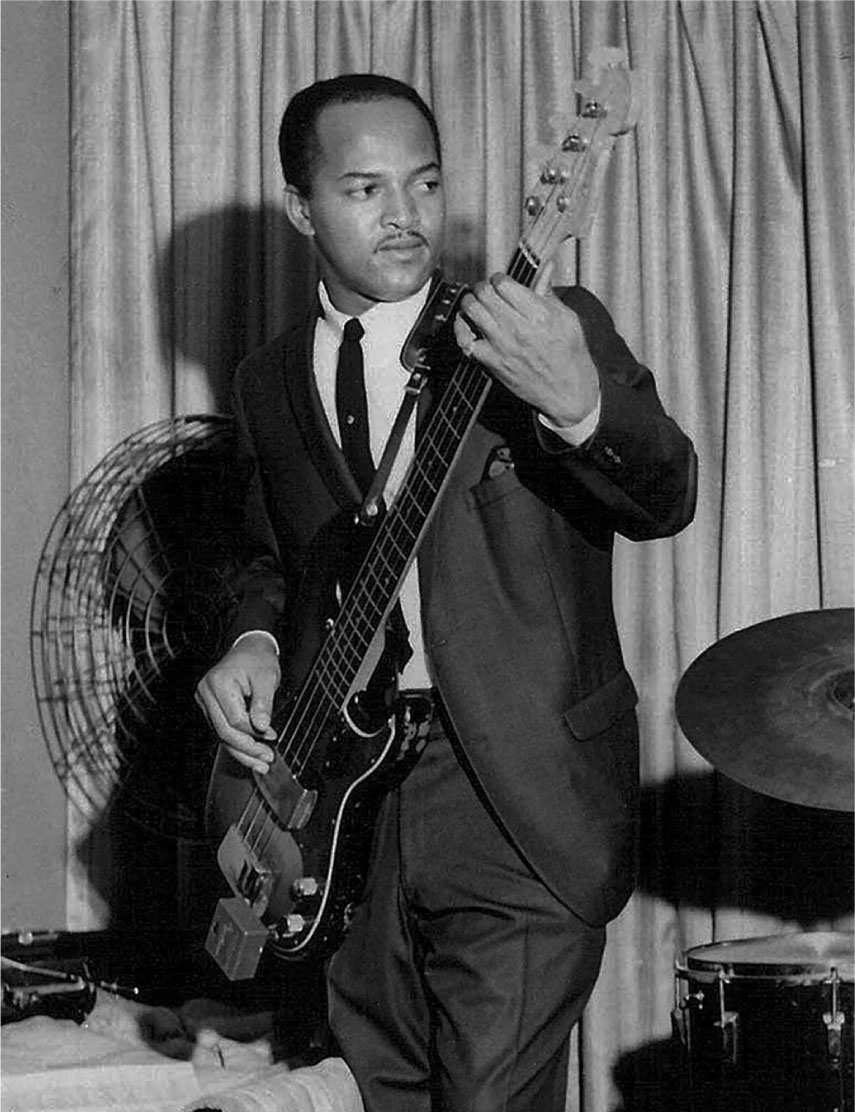
Precision Bass in the hands of Brian Wilson, Duck Dunn, and James
Jamerson. My interest in music was sparking, and soon enough I’d be poring
over album covers and rock magazines, identifying the guitars in the hands of
those stars.
 Fast-forward a couple of years: now a bassist with ambitions, ready to
ditch my cheapie bass and standing in a shop, about to buy a 1968 Fender
Precision. The salesman assured me it was a real “workhorse”—and I knew
straightaway that was something I planned to exploit. I surely did play that
thing, day and night. It was never far from my sight. I even loved the smell of
it! And so began my long, if interrupted, history with the brand.
Fast-forward a couple of years: now a bassist with ambitions, ready to
ditch my cheapie bass and standing in a shop, about to buy a 1968 Fender
Precision. The salesman assured me it was a real “workhorse”—and I knew
straightaway that was something I planned to exploit. I surely did play that
thing, day and night. It was never far from my sight. I even loved the smell of
it! And so began my long, if interrupted, history with the brand.
Fender has always been there in my life, not always up-front but as a kind
of benchmark by which all other basses are judged. I had some steamy affairs
with other brands such as Rickenbacker, Steinberger, and Wal, but something
about Fender would eventually draw me back. I learned so many
fundamentals with that ’68 Precision, and while there’s no denying
Rickenbacker’s influence along the way, since the mid-1990s my more
modern sound has been based on my Fender Jazz of 1972.
Of course, playing an instrument is one thing; knowing its genealogy is
quite another. If ever I had a question that even Skully couldn’t answer, we
sought out Terry Foster, the co-author of Fender: The Golden Age 1946–
1970, who probably knows more about Fender than anyone else on the
planet, and whose collection of Fender memorabilia squirreled away in his
Toronto home is mind-blowing. His insights (as with those of other
specialists in other chapters) have been a great help to me in my mad quest
and are sprinkled throughout the upcoming pages.
PRECISION BASS
I can still remember the feel of the wide neck and the rumble of the furniture
(and everything else, for that matter) in my teenage bedroom. When I first
plugged in that brand-new ’68 P-Bass and turned it up loud, it was such an
awesome, visceral moment that I didn’t stop to think about its origins. I
didn’t care then, but I certainly do now.
Leo Fender’s concept for the instrument was that anyone who could play
a guitar could now play the bass. He and his partner Don Randall named it
the “Precision” because with frets you got the notes you wanted, and in tune.
Everything that Leo did, in fact, was geared for utility, because first and
foremost the man was an inventor and a gadgeteer. Rather than hire luthiers
and seasoned craftsmen, such as those who worked over at Gibson, he mostly
employed factory workers. Fender in the early 1960s was a classic example
of the all-American assembly line.
After the Precision’s introduction in 1951, Leo kept tinkering with his
invention and making a ton of improvements over a ten-year period. I’ve
been fascinated to learn how that flat, stretched-out slab of wood morphed
into a more streamlined, curvaceous, and utterly reliable, not to mention
terrific-sounding, bass guitar that became the standard for so many musicians
of all stripes. Assembling this collection has reignited my love of the
instrument—playing them live on the R40 Tour, even more so. But enough
talk. Let’s take a look!
1952
Fender Precision Bass
BLONDE
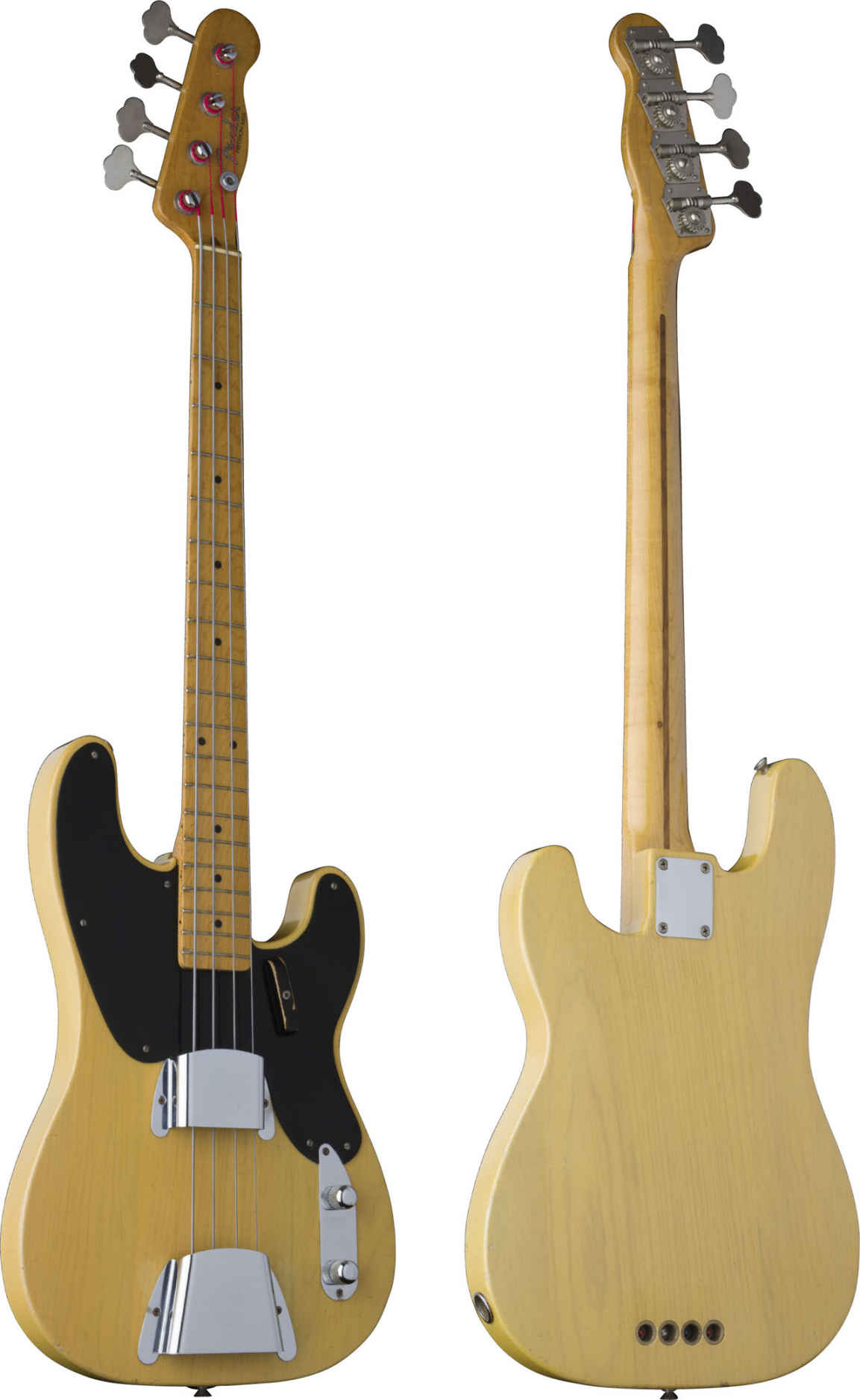
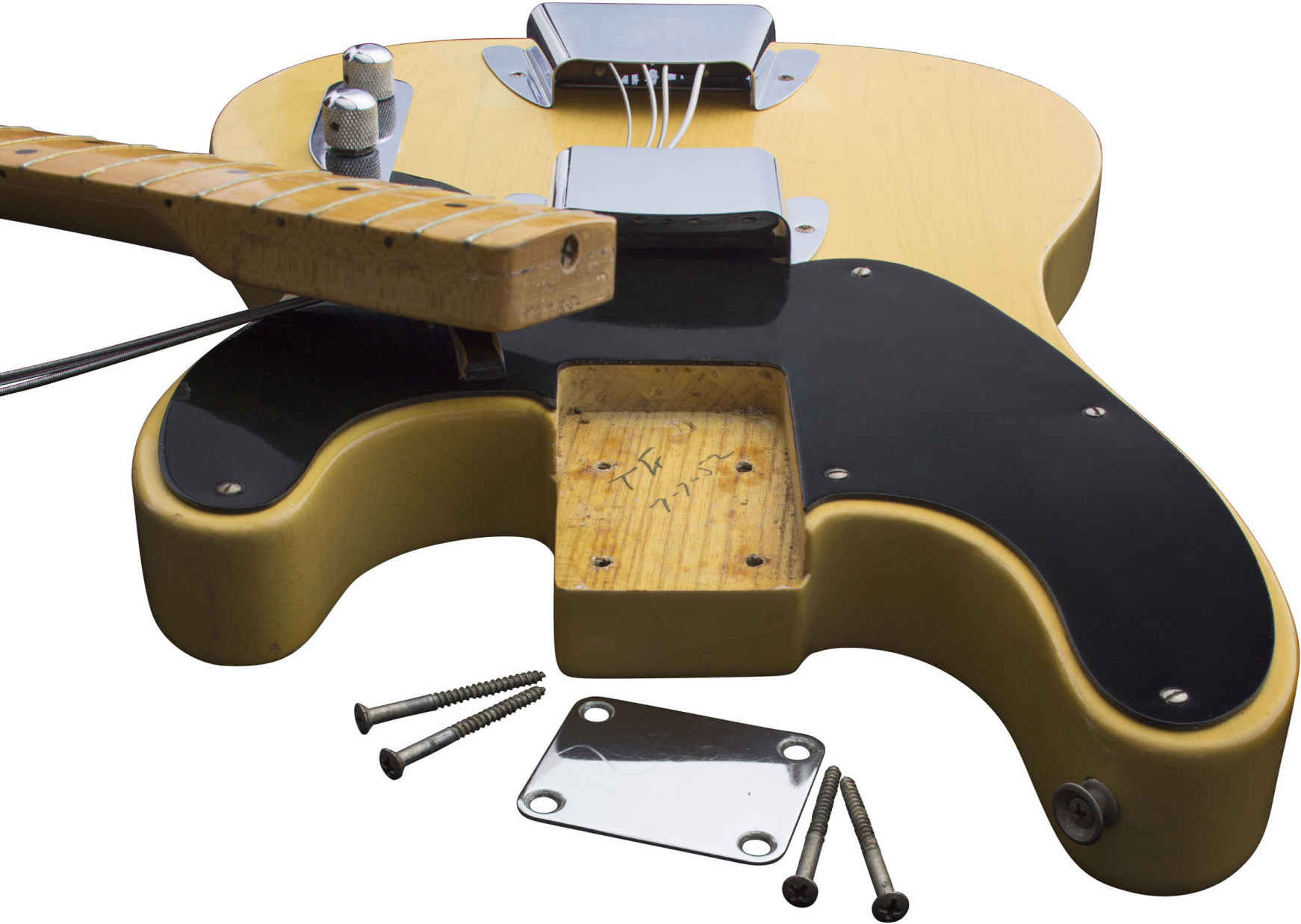
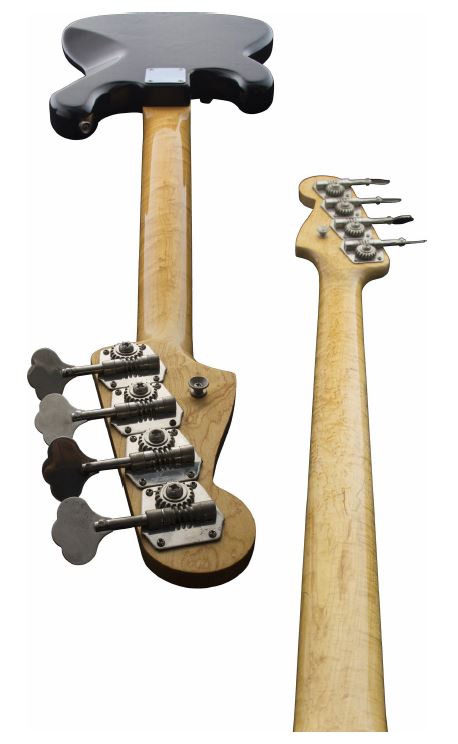
Bassmen! The electric bass arrives! It may not have been the very first, but it certainly was the first mass-production model. The Fender Precision was born in late 1951; this particular, pristine example dates to July 1952. One look, and you can see why it’s called a “slab”: a noncontoured ash body with a Blonde nitro finish and a one-piece maple neck. The truss rod is loaded from the back, and the slot is filled with a walnut strip commonly referred to as the “skunk stripe.”
Mon dieu! Shock, horror! We dared to turn the screws on this all-original sixty-plus-year-old beauty, so you could see the details of the neck assembly. Here’s a good look at the black fiber pickguard with its finish of lacquer that adds depth and shine, as well as the neck and body dates written in pencil by “TG”—Tadeo Gomez, one of Leo Fender’s workers.
1953
Fender Precision Bass
BLONDE
This 1953 Fender Precision Bass Blonde marks the beginning of my madness: it was my first 1950s acquisition. Wine geeks like me look for vintages from their birth year, so naturally I wanted the same in a bass. Now you know how effin’ old I am.
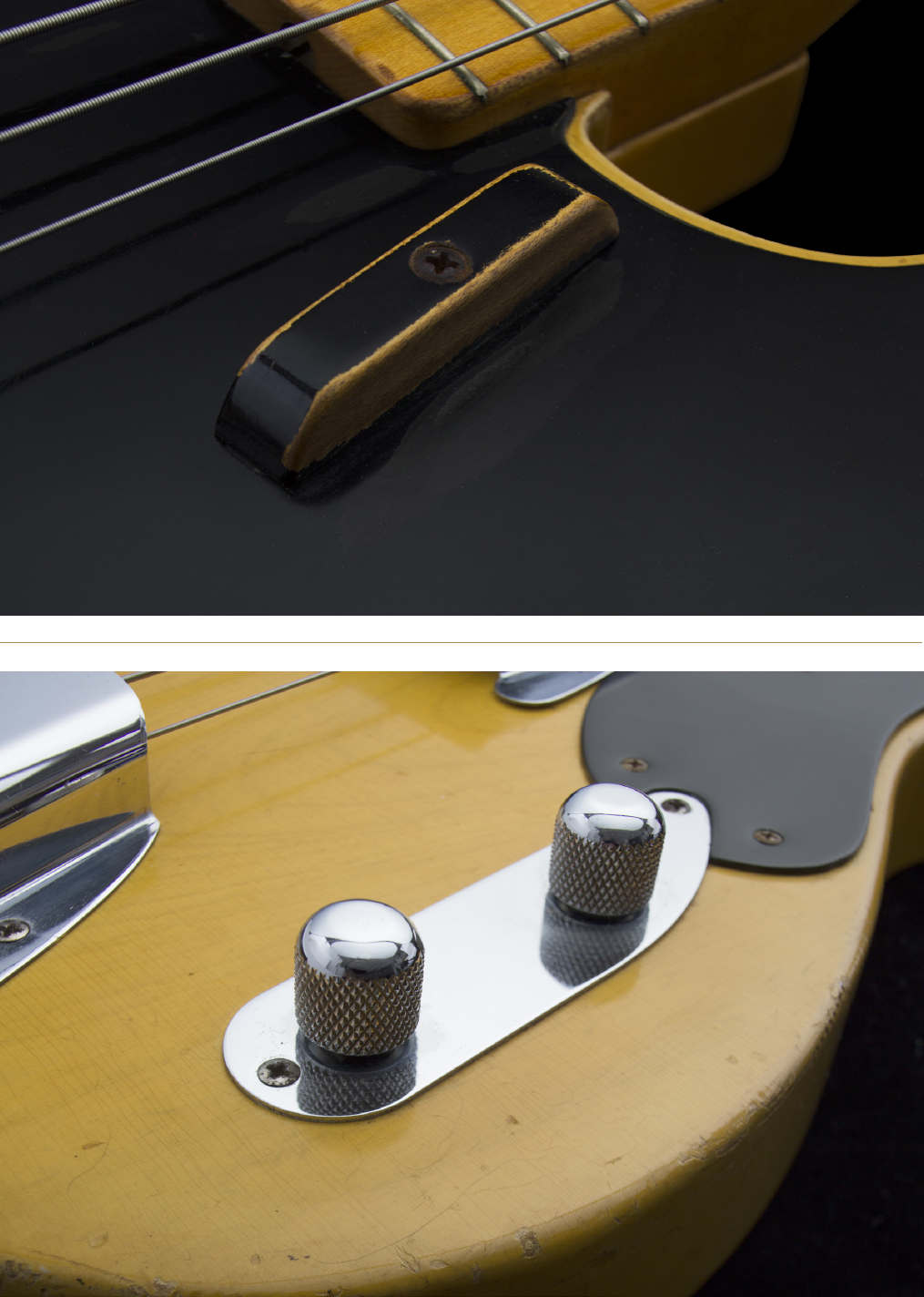
Originally designed for the Broadcaster and made in small batches, the early profile of the tone and volume knobs subtly changed over the years: the ’52 and ’53 both had slightly rounder domes, were flatter on top by 1955, and continued morphing until 1957, when they achieved the flattop shape they still have today. Regardless, they’ve proved indestructible.
NO BASS!
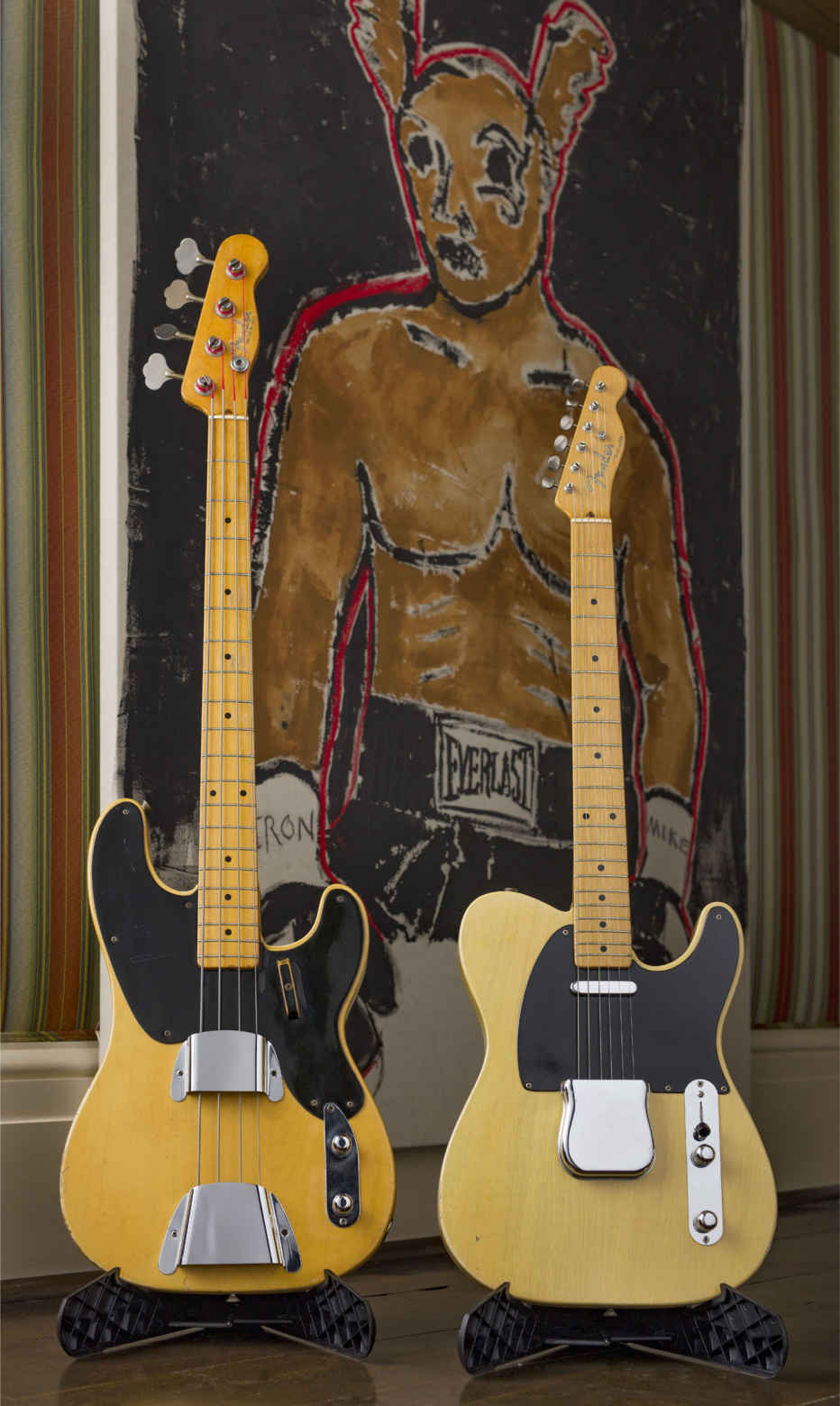
In late 1949, Leo Fender’s partner Don Randall returned from the National Association of Music Merchants (NAMM) trade show, where he’d exhibited Fender’s new Broadcaster (later called the Telecaster, due to copyright issues) guitar. Everyone had laughed at the “plank and canoe paddle,” but Don’s most urgent concern was getting a truss rod in the thing. Leo was famously frugal and didn’t think it was needed. He thought of his instruments as modular consumables: when your frets wear out, just bolt on a new neck. A truss rod would take time and finesse to install. But in the end, Leo found a clever way to do it without having to create a more expensive two-piece neck. The important point, Terry Foster argues, is that without that truss rod, Leo would never have been able to make a bass—not with that scale of neck, a neck that could withstand the tension of its strings. The next most urgent issue was, where do you even get strings for an electric bass? Leo’s solution? Use piano strings.
1955
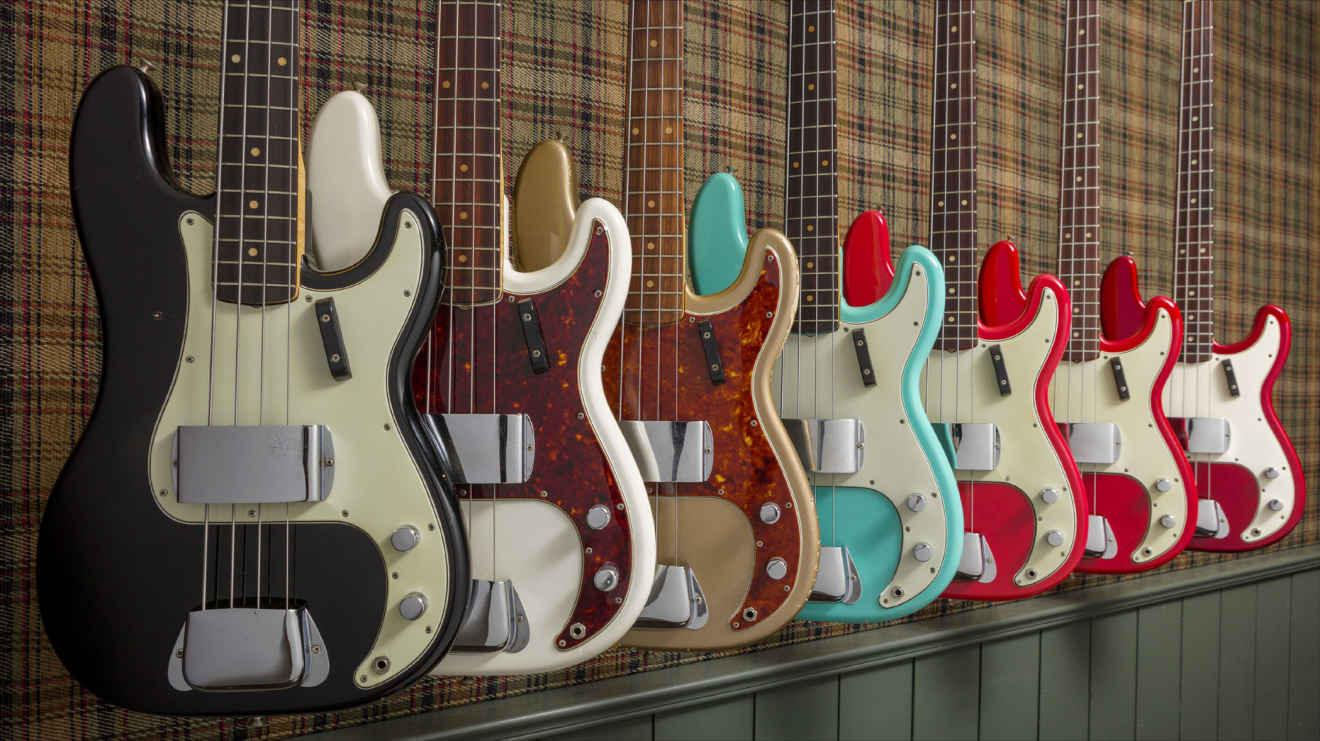
From 1951 to 1960, the Precision Bass was in a state of almost continuous transition, as Leo sought to perfect his bass. The first significant change came in 1954, when the shape of the instrument began to move away from the slab to the more comfortable Strat-like contoured body, as the P-Bass began to resemble that of the bass we know today.
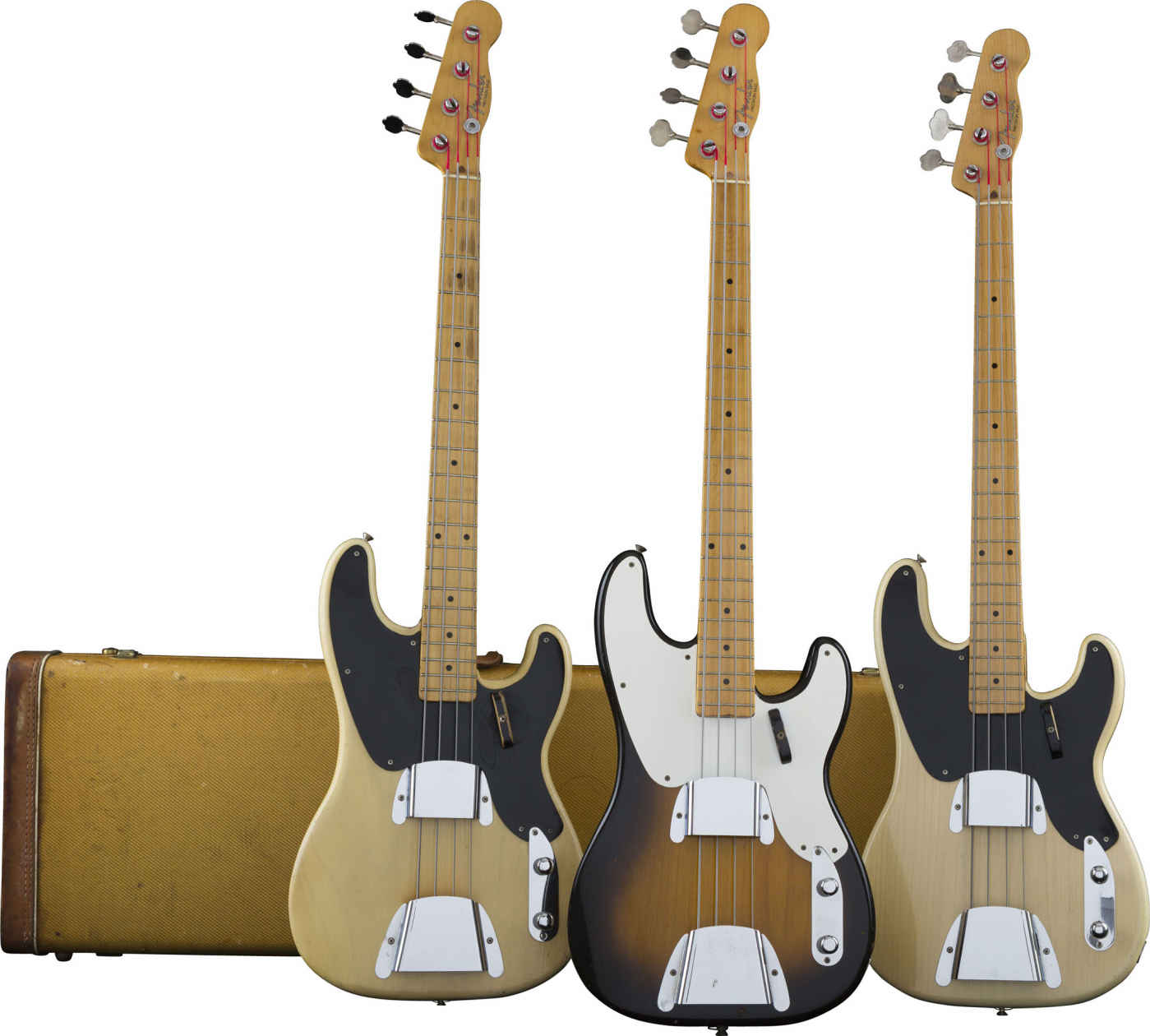
Left to right: The Precision Bass’s first transition period: early ’55 Blonde, ’55 Sunburst, later ’55 Blonde
1955
Fender Precision Basses
BLONDE
Changes afoot. As of 1954, steel saddles were replacing phenolic. The serial number is still visible on this bridge plate, yet that same year the placement of the serial number was transitioning to the neck plate. Some basses exist with the serial number in both locations.
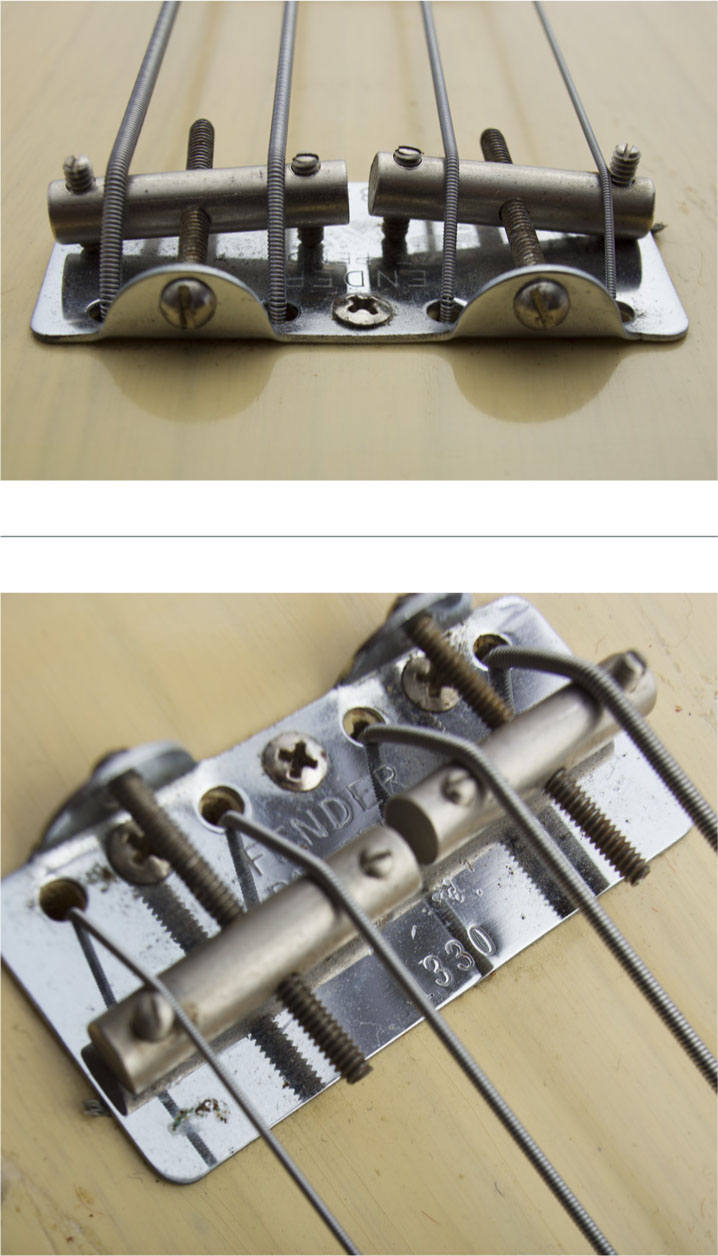
An example of a later bass with the earlier phenolic saddles. Nothing goes to waste in a guitar factory.
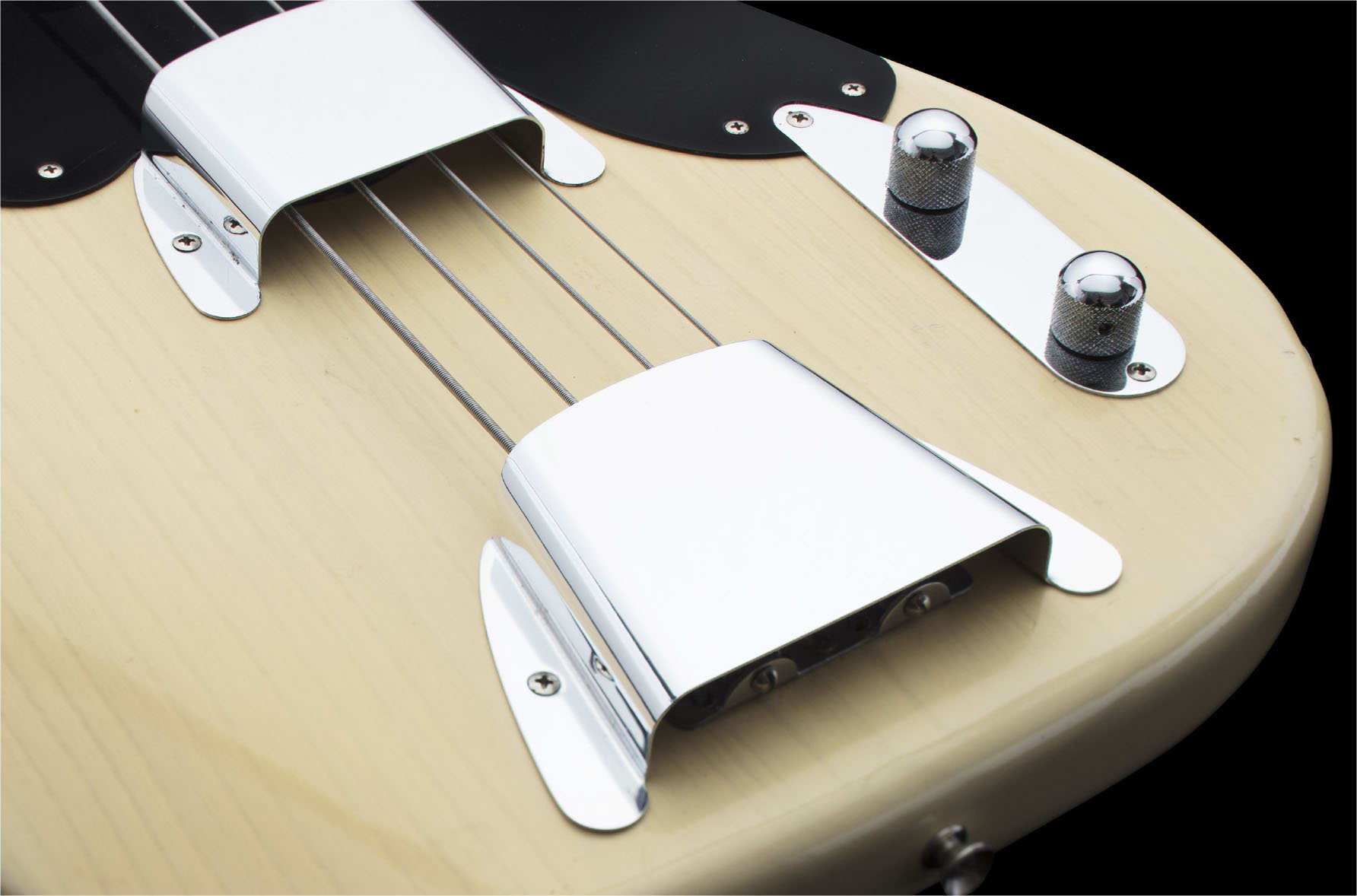
Fender typically used “swamp ash” for these see-through Blondes, as opposed to alder for the Sunbursts. It took much more work to prep ash because of its porous nature—it had to be filled in with a shellac sanding sealer—but the beauty of the result is self-evident.
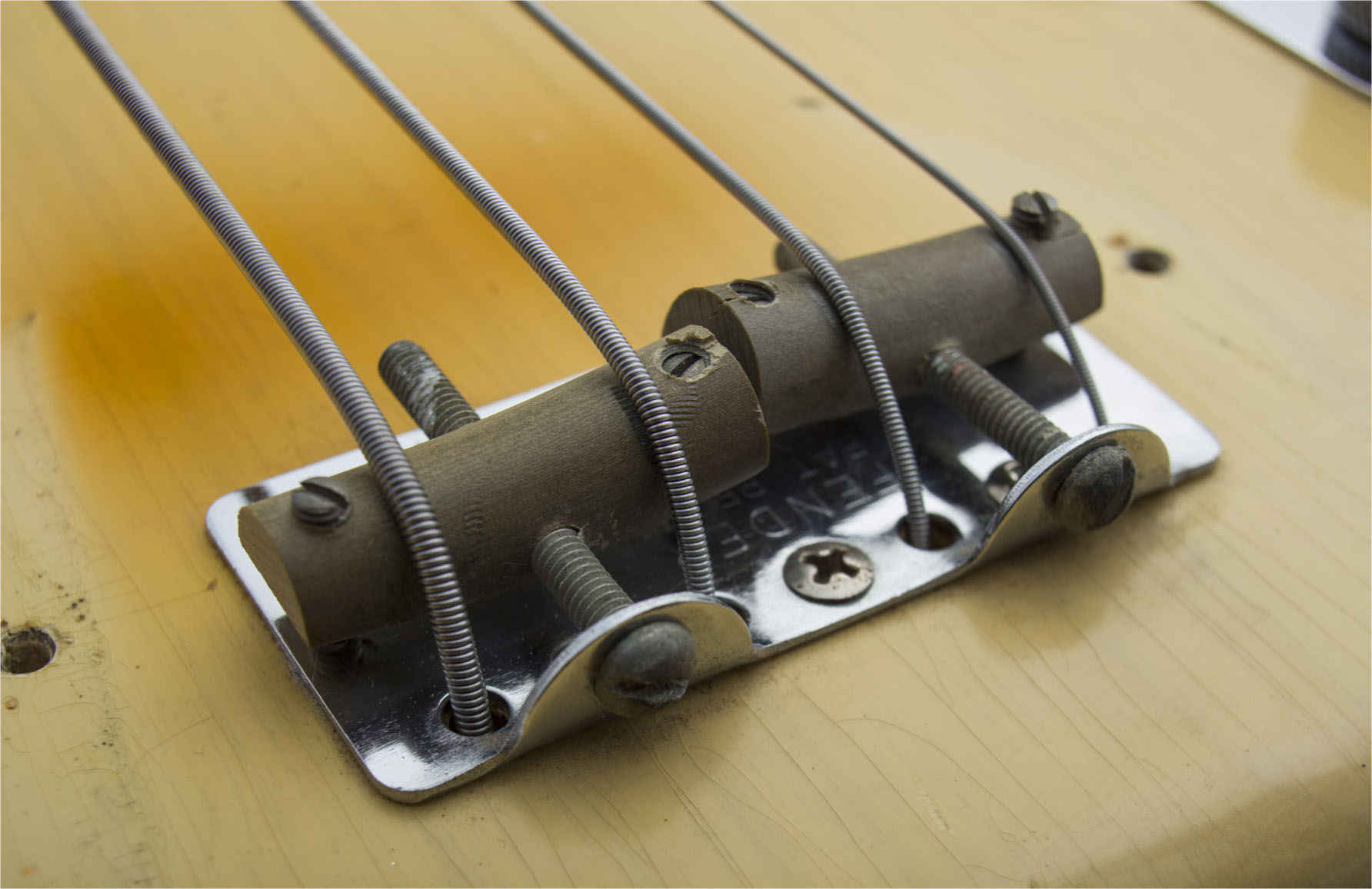
Out of curiosity, I played both of these Blonde ’55s back to back for quite a while to see if I could discern a noticeable difference attributable to the phenolic saddles as opposed to the steel. It must be said, the results are inconclusive, as no two pickups are identical. However, the bass with steel saddles was a little brighter and had more sustain.
1955
Fender Precision Bass
SUNBURST
In 1955, the transition continued with the introduction of the new two-tone Sunburst finish. This one is made of alder, and has a gleaming white plastic pickguard.
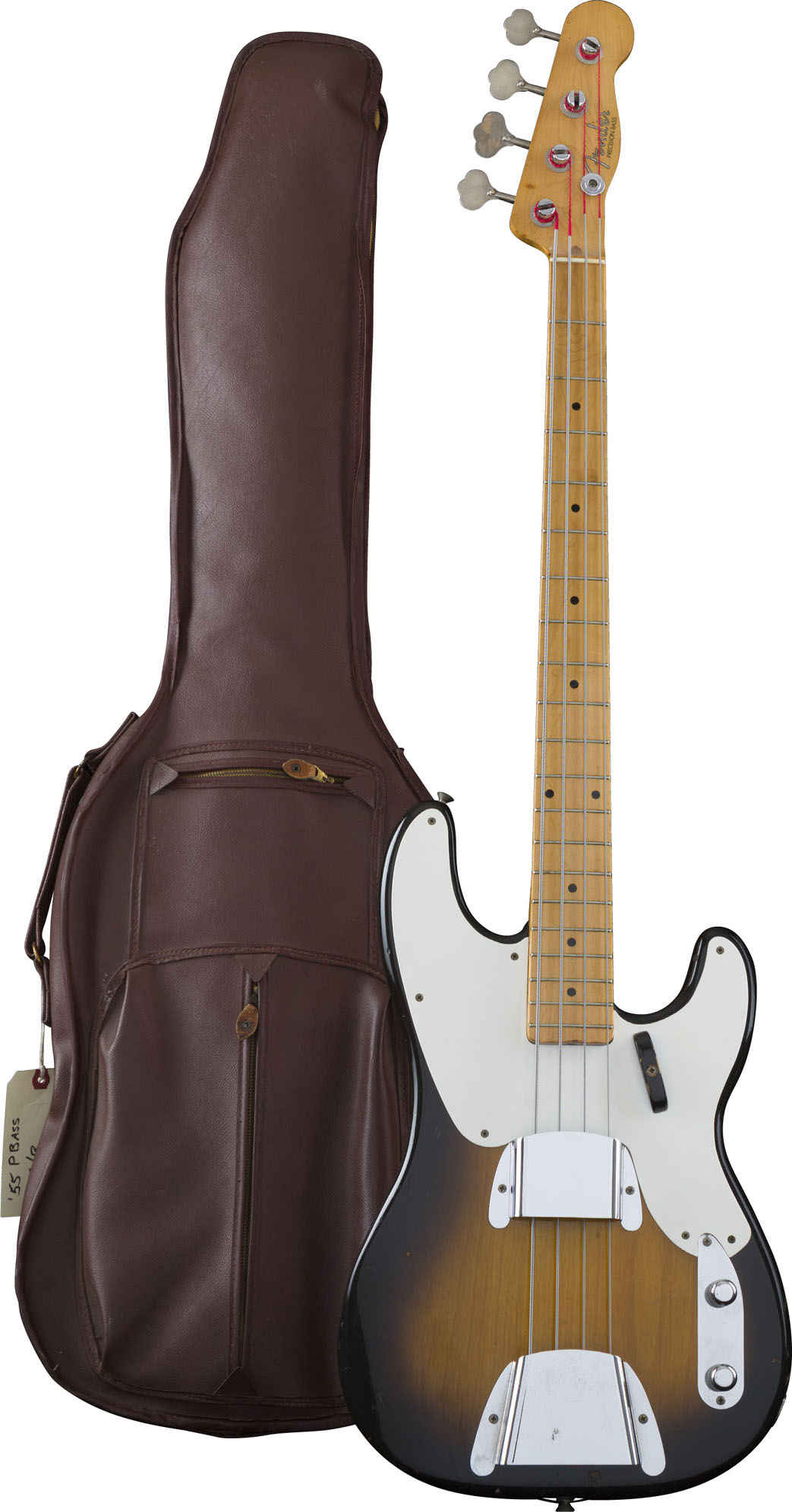
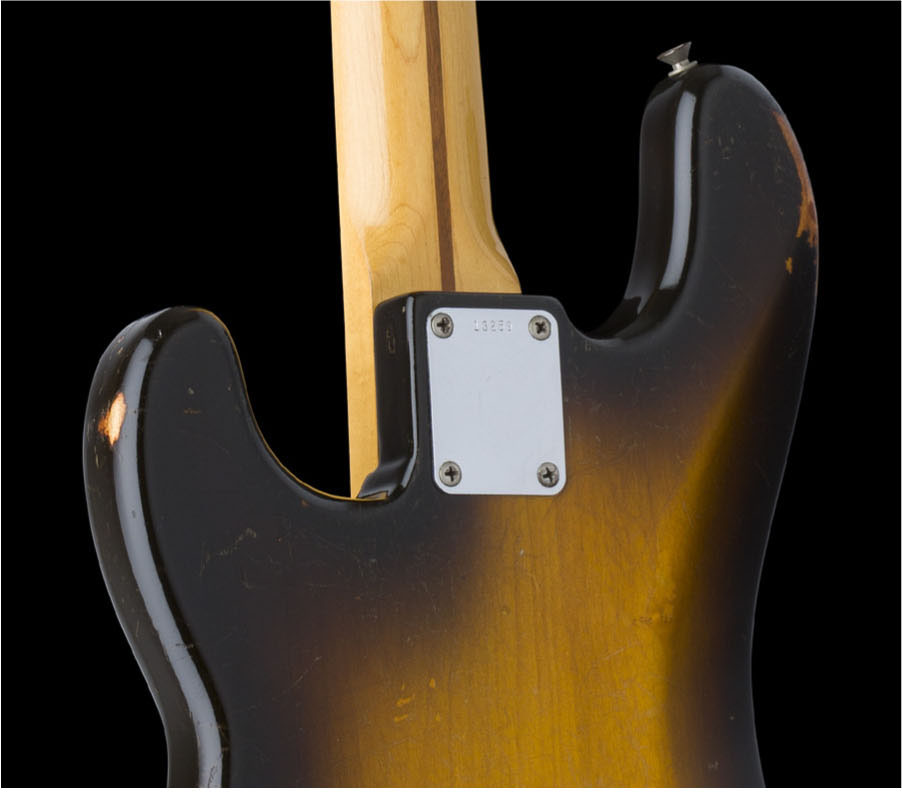
The serial number, no longer visible on the bridge, fully transitioned to the neck plate in 1955.
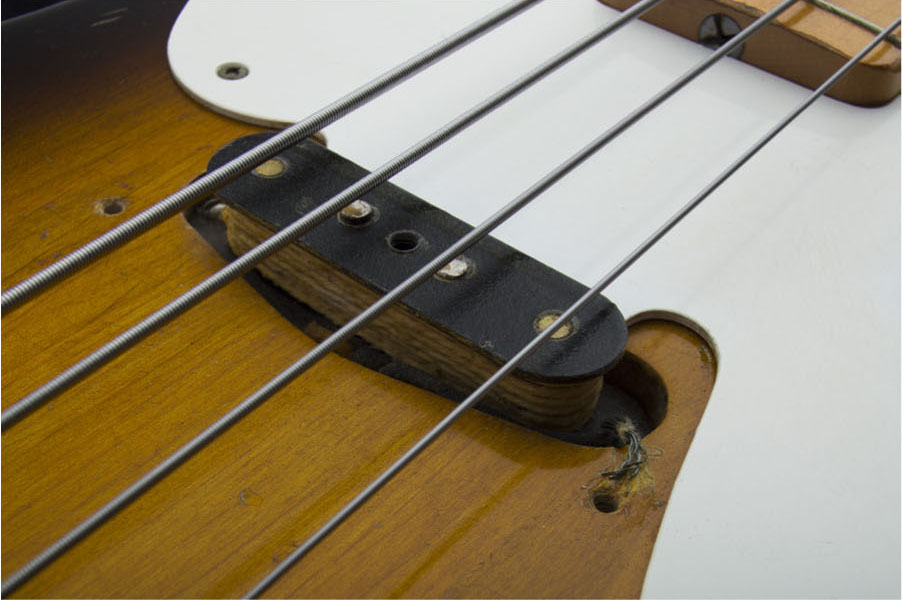
These black staggered pickup poles were introduced in 1954, in an attempt to balance the output of each string.
1956
Fender Precision Bass
BLONDE
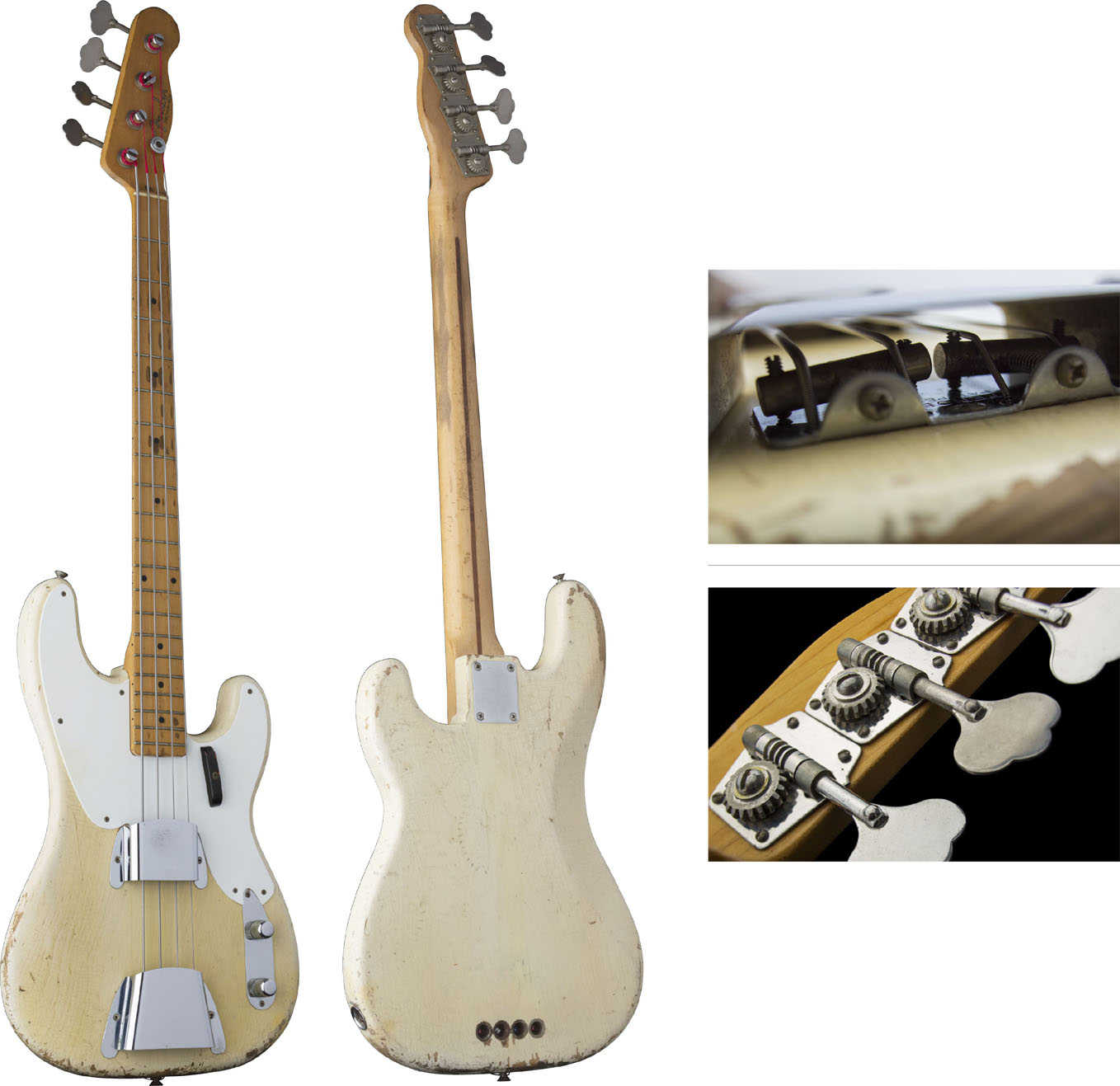
From a year that mostly saw Sunbursts being produced came this well-loved bass with the rare combination of Blonde finish and an original white guard.
1958
Fender Precision Bass
TWO-TONE SUNBURST
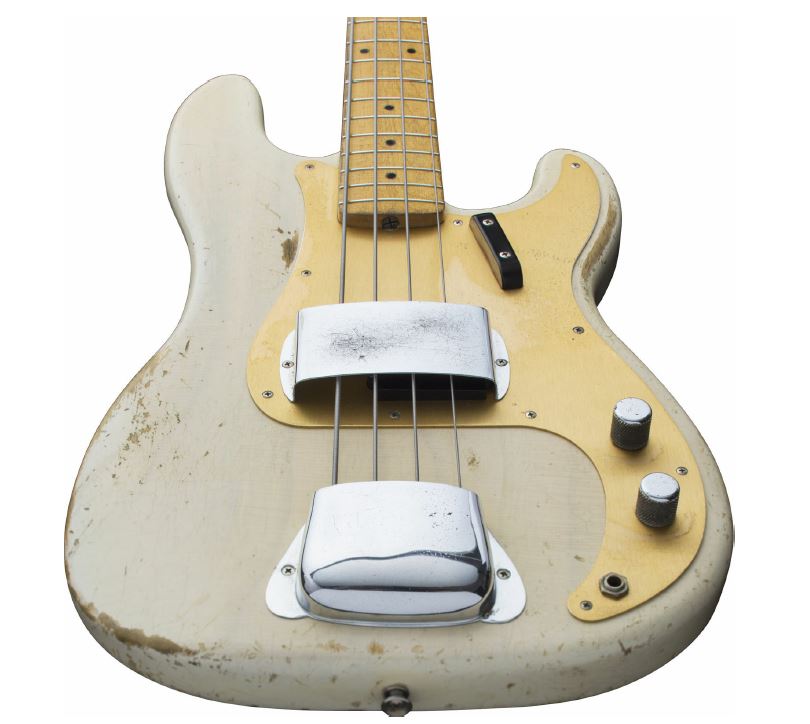
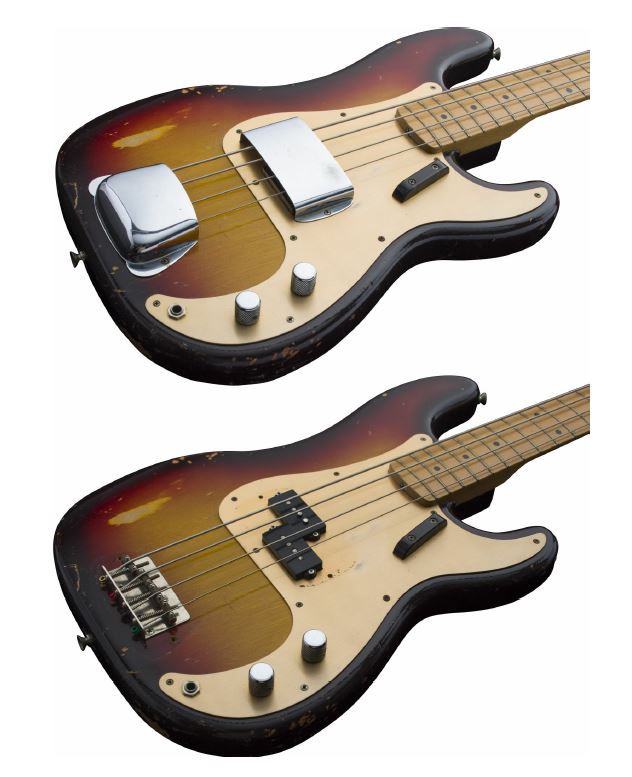
New! New! New! As of 1957, the P-Bass design was coming ever closer to the instrument we recognize today. This early ’58 (below, left) shows what’s happening: pickup, bridge, knobs, headstock shape, covers—all-new designs —plus my personal favorite, the super cool, gold anodized aluminum pickguard, which remained through 1959.
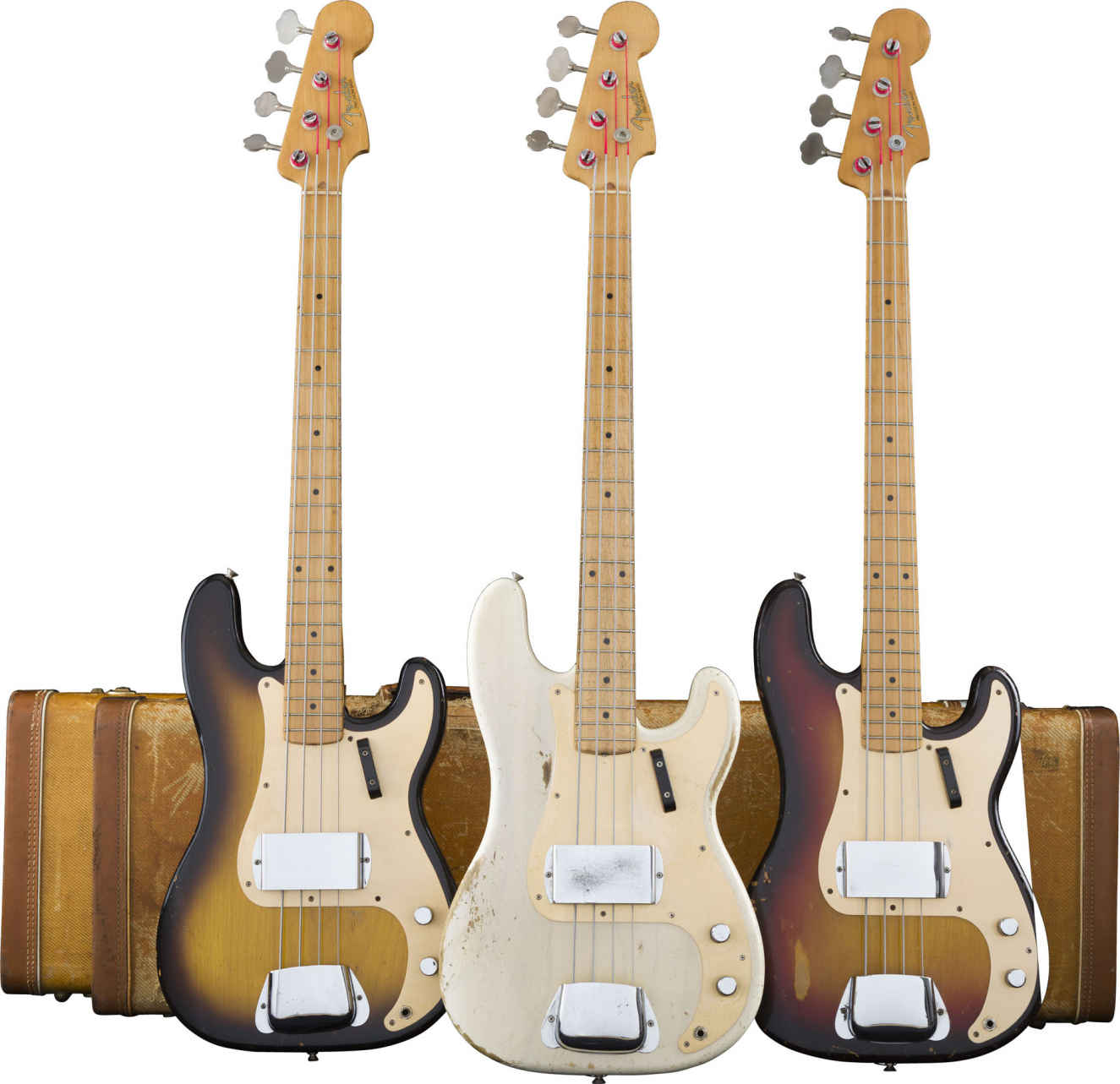
Left to right: ’58 two-tone Sunburst, Blonde, three-tone Sunburst
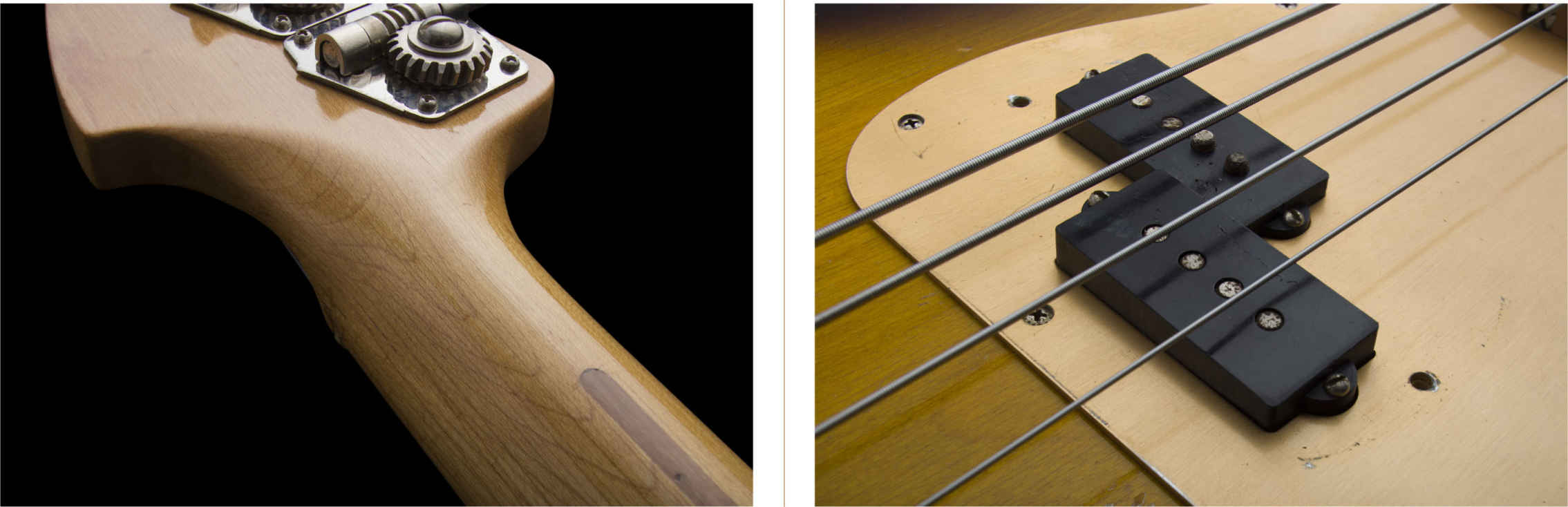
Left: This is the only Precision I have from the 1950s that has a pronounced V-shaped neck. Apparently Fender played around with these between early 1957 and mid-1958. Neck shape is down to a player’s personal preference. This “strong” pointy V feels somewhat chunky in my hands, and though that’s not my usual choice, when I discovered the bass in a shop in Tokyo I found myself joyfully playing it for more than an hour. Right: The newly redesigned split pickup wired to reject hum.
1958
Fender Precision Bass
BLONDE
See-through Blonde with an anodized guard is a pretty rare combination. Although this one’s been well played, to me it’s still—as collectors say—a super find.
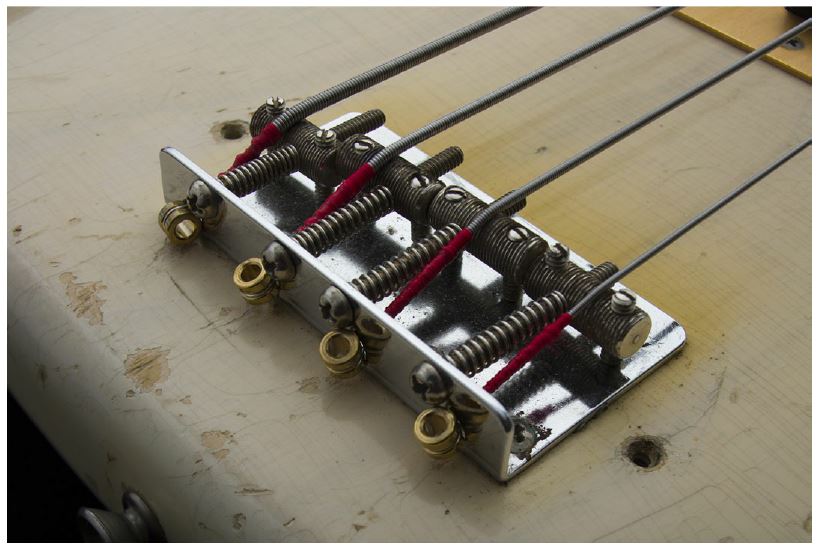
The redesigned bridge now features individual fine-threaded saddles for each string, allowing for more accurate intonation adjustment. The strings no longer pass through the body. This bridge would be manufactured for only a short time before being modified yet again.
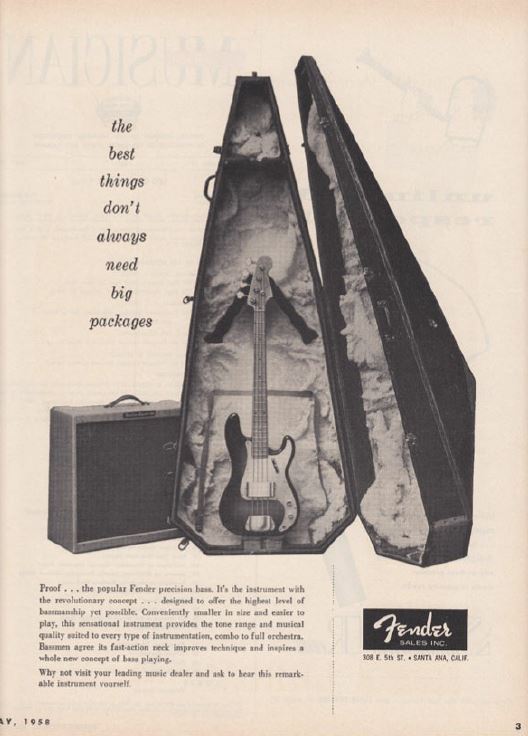
TAKE A FENDER ANYWHERE
When big bands toured the land, the biggest pain was schlepping that big old bass around. Remember the 1990 TV drama Elvis about his early days on the road? There’s Bill Black attaching his bass to the roof of the car, in all weather, because it doesn’t fit in any car—even with the enormous automobile trunks of the 1950s and 1960s. So, whatever resistance there might have been among traditional musicians to the new instrument, one inarguable appeal of the Precision was its portability.
1958
Fender Precision Bass
THREE-TONE SUNBURST
The now-familiar three-tone Sunburst arrives.
1958
Fender Precision Bass
OLYMPIC WHITE
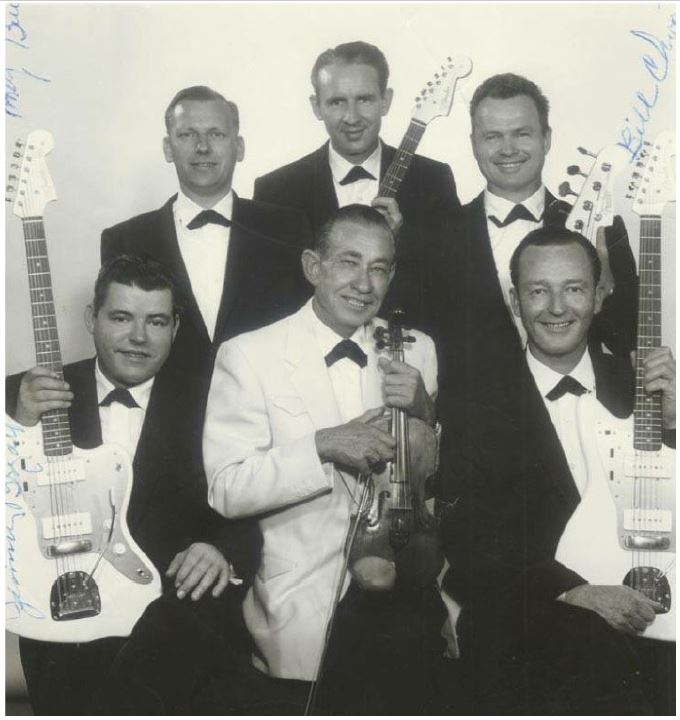
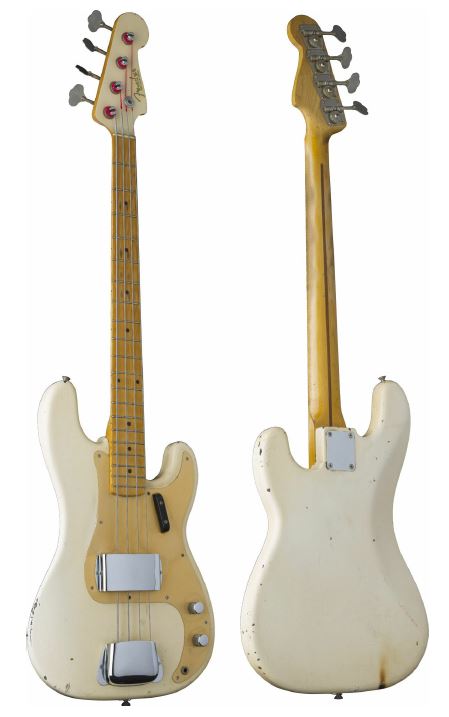
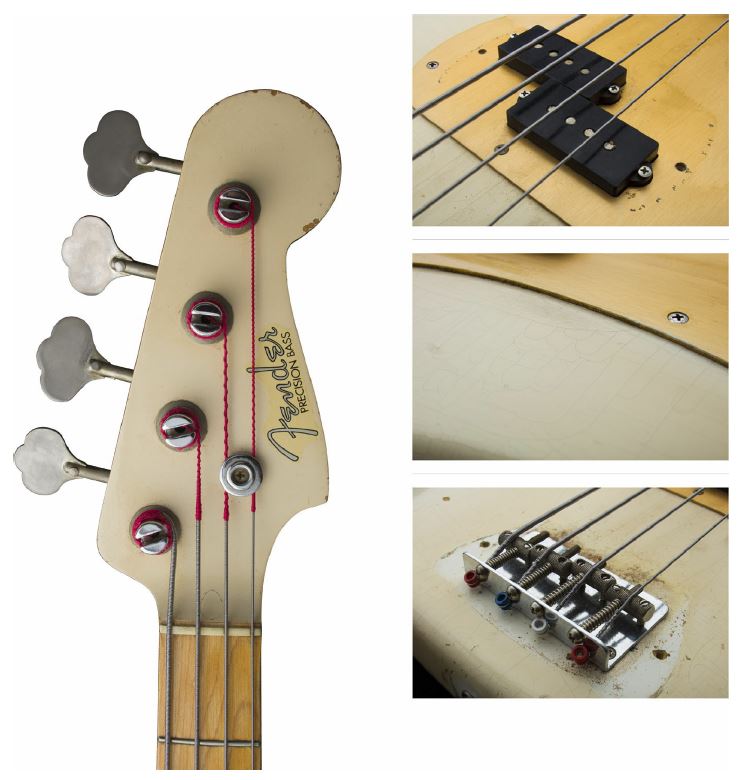
This is one of the jewels of my collection. As you can see, it’s Olympic White with a matching headstock—almost unheard of on Precision Basses. It was made as part of a matching set for Jimmy Bryant, a.k.a. “the Fastest Guitar in the Country,” and his bandmates. Although the history is mostly anecdotal aside from a few photographs, we do know that the set consisted of at least two Jazzmasters and this Precision Bass—when Bryant, along with Rue Barclay and Bill Choate, were playing in the New Sons of the Pioneers (as seen in the photograph below). Jimmy Bryant and the Night Jumpers appear in the 1963 movie The Skydivers, in which you can check out Rue Barclay playing this very bass. Barclay owned and used it throughout most of his career, until he sold it to the vintage guitar dealer in LA from whom I purchased it.
Physically, this bass has survived quite nicely, apart from a very strange burn mark on the bottom, and it’s one of the best-sounding P-Basses that I own. In fact, when I used it on Rush’s final tour, R40, it was a fave of fans, who consistently singled it out for its tone—which I would describe as having a strong, punchy bottom end and clear, taut top-end definition. Oh, and this is also the year they reintroduced flat pole pieces to the pickup.
1959
Fender Precision Bass
SUNBURST
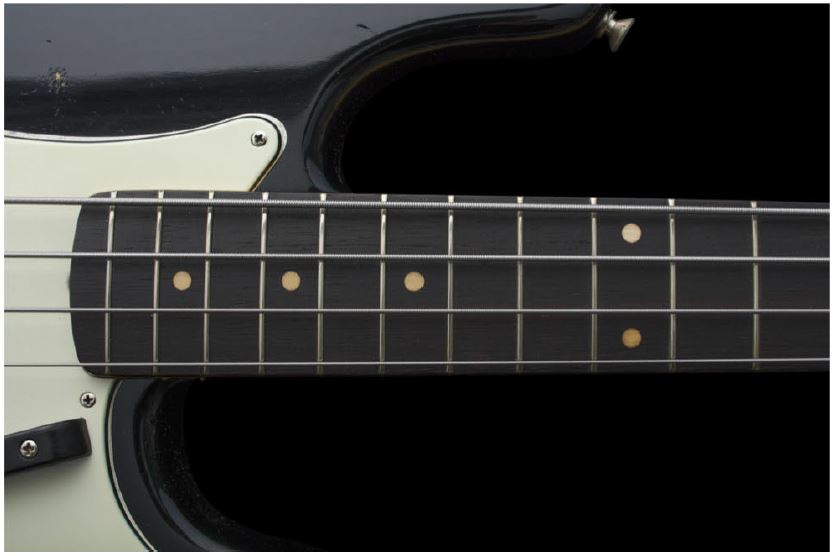
In many ways, and certainly to a player as opposed to a collector, this is one of the most sought-after versions of the late 1950s Precision Basses. It boasts a rare combo: a gold guard and the newly introduced rosewood slab fingerboard. It makes me think of Donald “Duck” Dunn of Booker T and the MG’s; although he’s mostly identified with a ’58 maple neck P-Bass, serious fans know that his first Precision was a ’59 model with a slab board. As legend tells it, in 1967 Duck loaned that ’59 to the bass player in Otis Redding’s band, and it disappeared in the same crash that so tragically took the lives of Redding and most of his musicians.
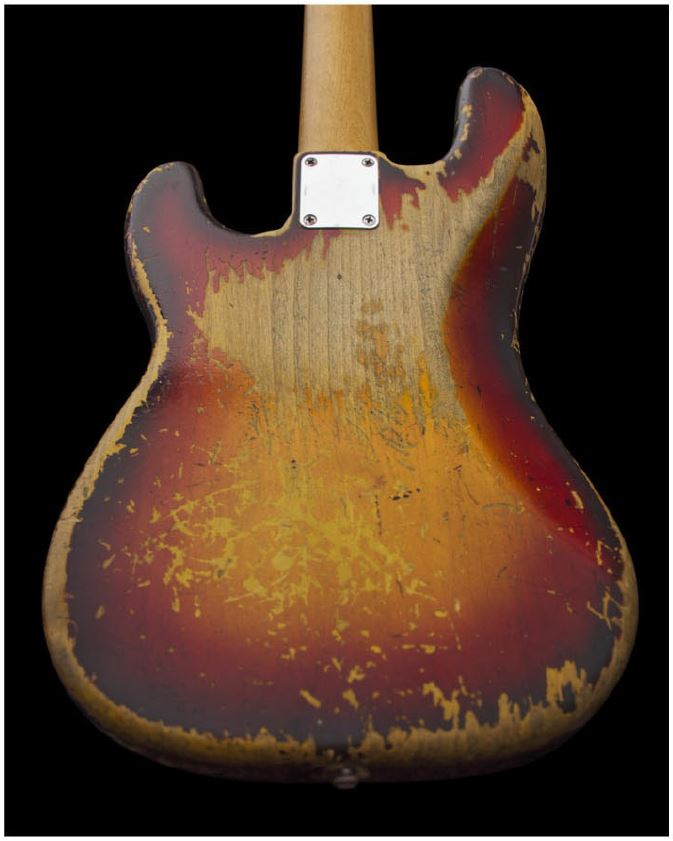
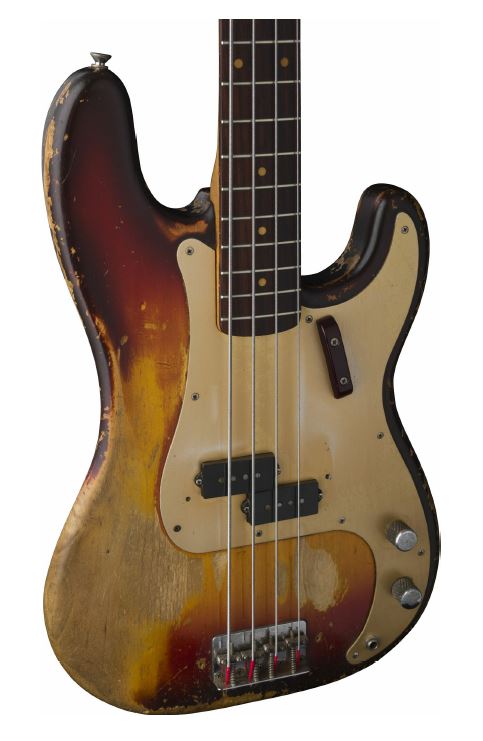
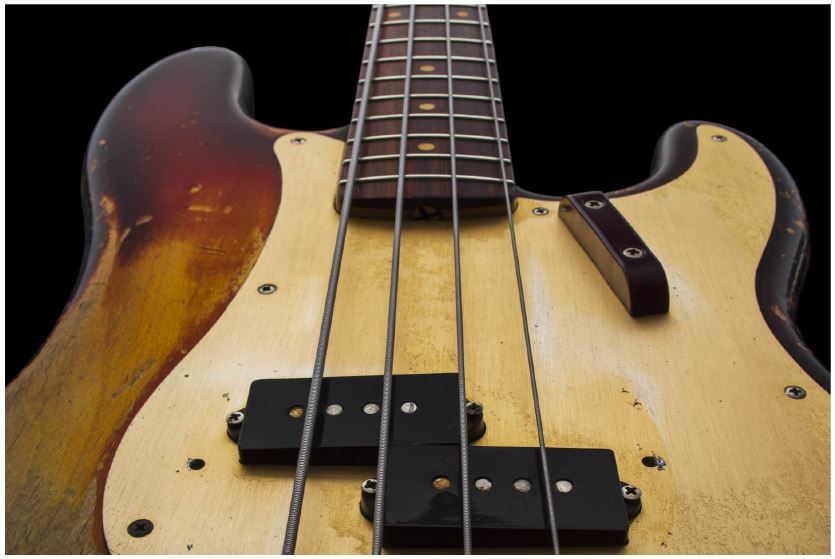
Aside from the fact that this bass oozes visual mojo, it’s a real joy in my hands, with a classic P-Bass tone that reminds me of so many songs I grew up listening to without realizing it was Duck grooving on them. The first time I picked this bass up to test it out, I instinctively found myself playing Wilson Pickett’s “In the Midnight Hour” once again. (Yes, I played those songs in my basement band years!)
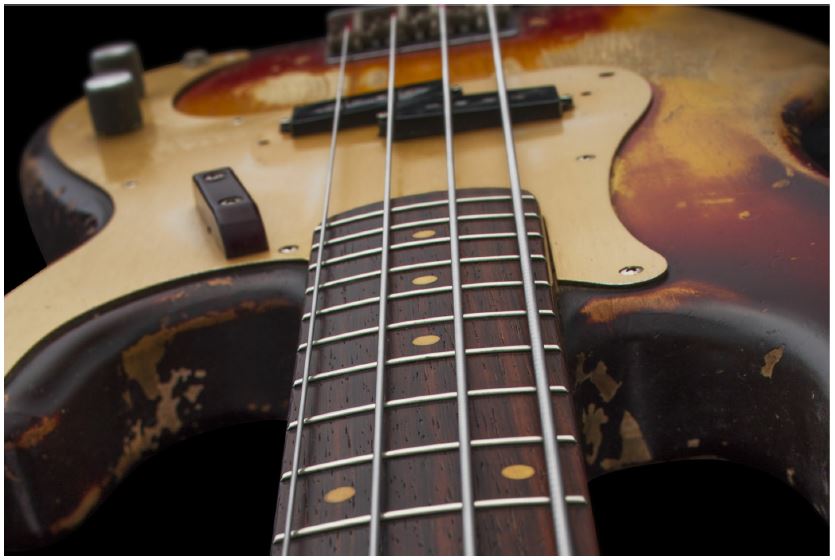
If “clay” dots were really made of clay, they’d dry up and fall out, so what were Fender fret dots really made of? One crazy story that feeds the legend of Leo’s thriftiness is that he repurposed old linoleum from the Fender factory floor. According to The Stratocaster Chronicles by Tom Wheeler, they were made from “a fiberboard, similar in composition and thickness to their pickup coil form-tops.” But I think I’m going to go with John Page, master builder at the Fender Custom Shop from 1987 to 1998, who’s said that it was most likely “a material called ‘Harvite,’ a fine-clay-impregnated phenolic resin that was also used in old poker chips and hotel key fobs. I guess it’s no longer manufactured, but go to the swap meets and look for old clay-colored poker chips . . . you can make dots out of them. Really!”
1960
Fender Precision Bass
BLACK
To the modern player Black is a common color, but in the late 1950s and early 1960s it was a pretty rare custom order. This particular bass, having spent much of its life in a case unplayed, is a minty collector’s prize. (As my friend Colin says, “Johnny got a guitar for Christmas, but he wanted a drum kit.”)
1961Fender Precision Bass
OLYMPIC WHITE
The Olympic White is equally pristine: an unusual example of an instrument that left the factory with no clear coat. With a lovely piece of flamed maple behind that rosewood fingerboard, and a sound that’s deep and true, it’s one of the top P-Basses in my collection.
It’s unusual to see a green guard on a P-Bass before late 1962 (we suspect Fender fitted them only on Black ones). So-called “green” guards began life as white, but aged to varying shades of grayish green due to environmental exposure. They were made of nitrocellulose—a highly flammable compound that, when used as an explosive, was originally known as guncotton. Nitro guards have a common tendency to shrink and crack, and, according to legend, also to catch fire. None of mine have . . . yet.
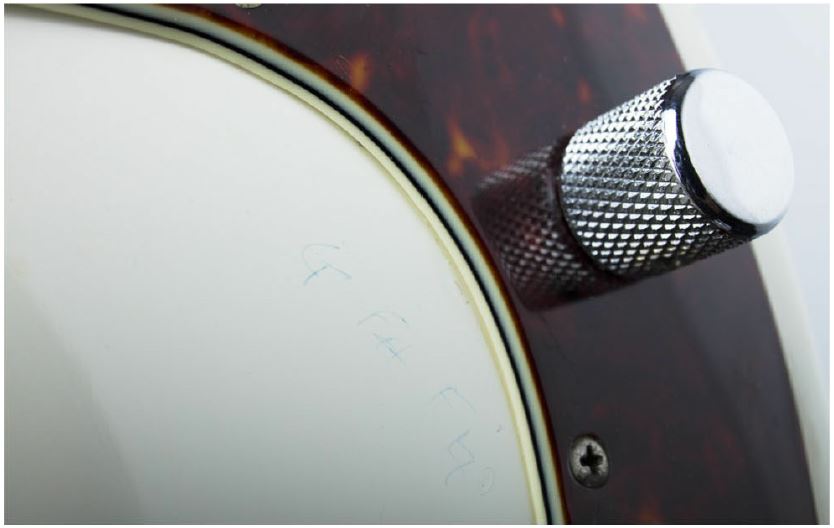
“G, F#, F♮” ? Dude, don’t write on the bass!
1961
Fender Precision Bass
SUNBURST
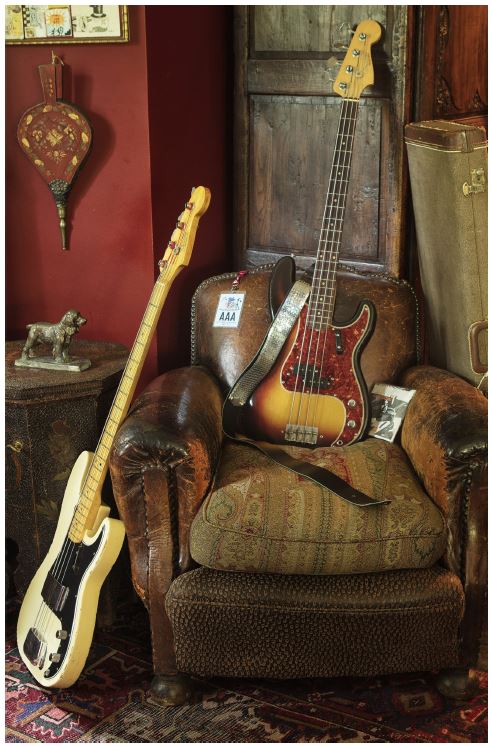
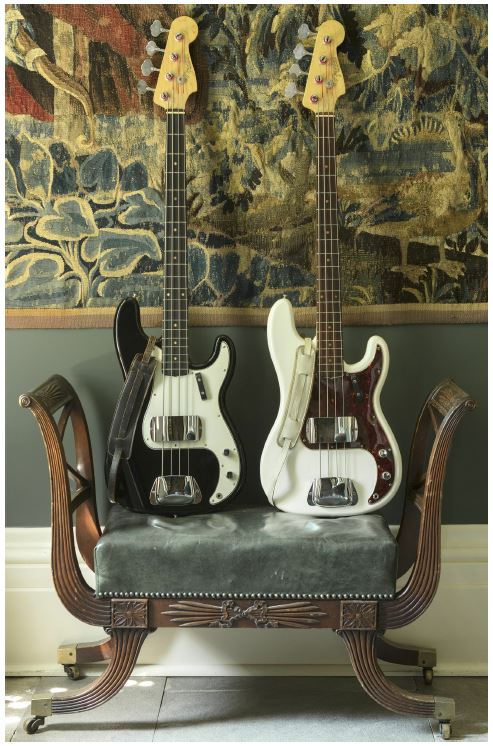
Look at this chair. Have you ever seen such a chair? Oh—on this chair rests a bass that has significant meaning for me. Pictured with one of his straps from Manny’s in NYC, it belonged to John “The Ox” Entwistle of the Who, who was and remains a hugely influential player in my life. I was fortunate enough to acquire this P-Bass from my friend and long-time Who employee Alan Rogan (interviewed later in the book), who describes how John was always playing, and used to sit around his house noodling on it. I am never changing the strings.
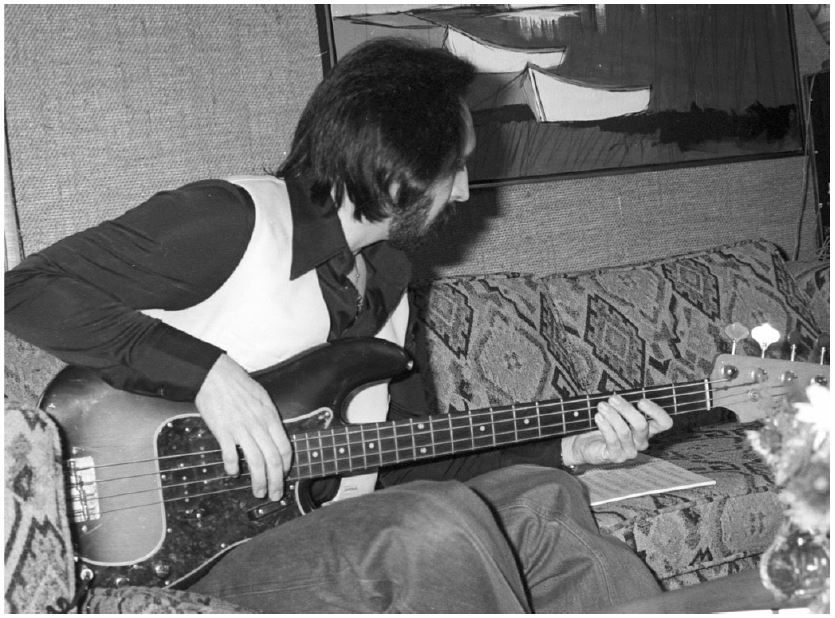
The man himself rehearsing in his hotel room in 1979 (Michael Ochs)
1962
Fender Precision Bass
SHORELINE GOLD
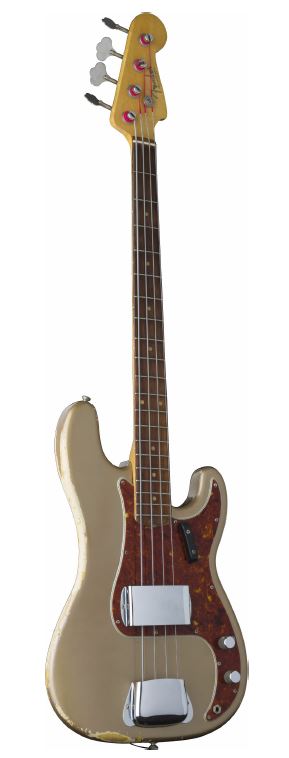
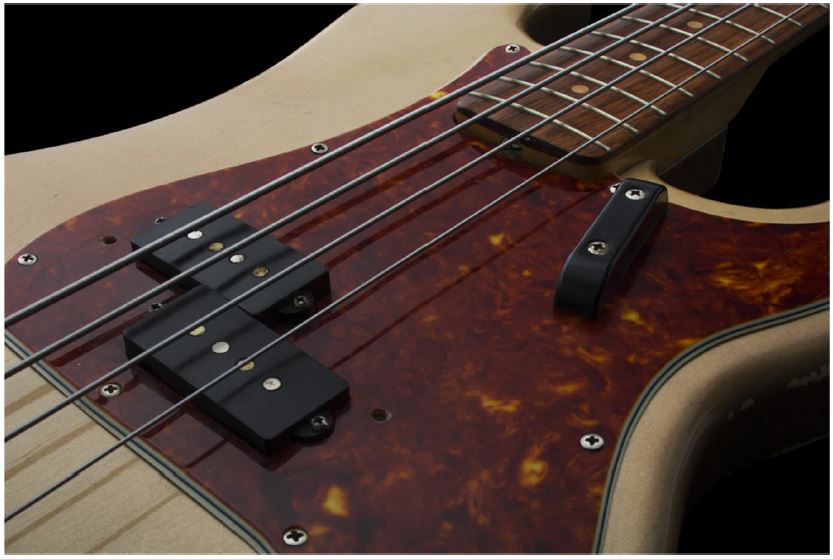
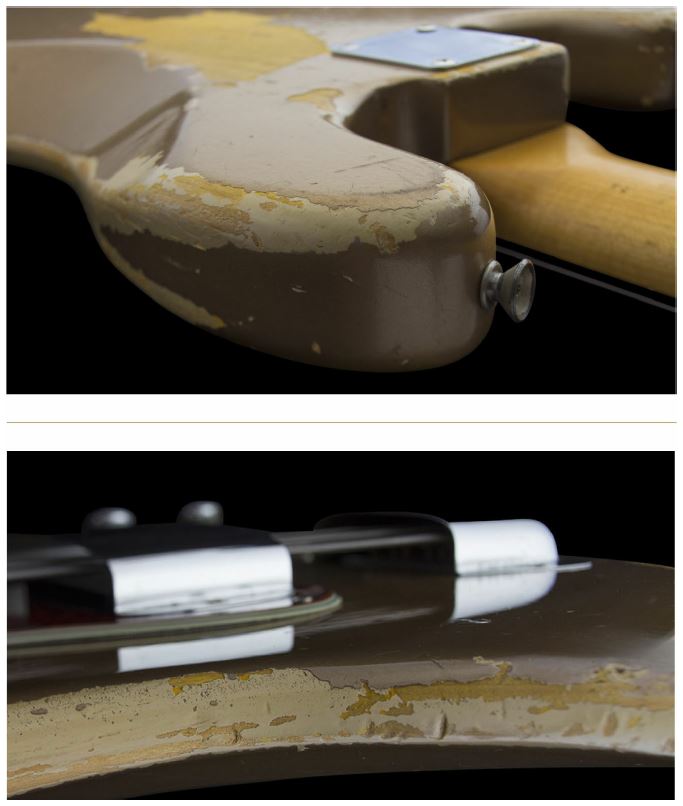
Above and below: Pre-CBS Shoreline Gold is hard, and thrilling, to find in any condition. Like a few other custom colors, this one varies slightly from instrument to instrument, partly due the yellowing clear coat, and partly to color formulas (see here). Shoreline Gold was introduced in 1959 and replaced in 1965 by Firemist Gold, a still cool but very different color.
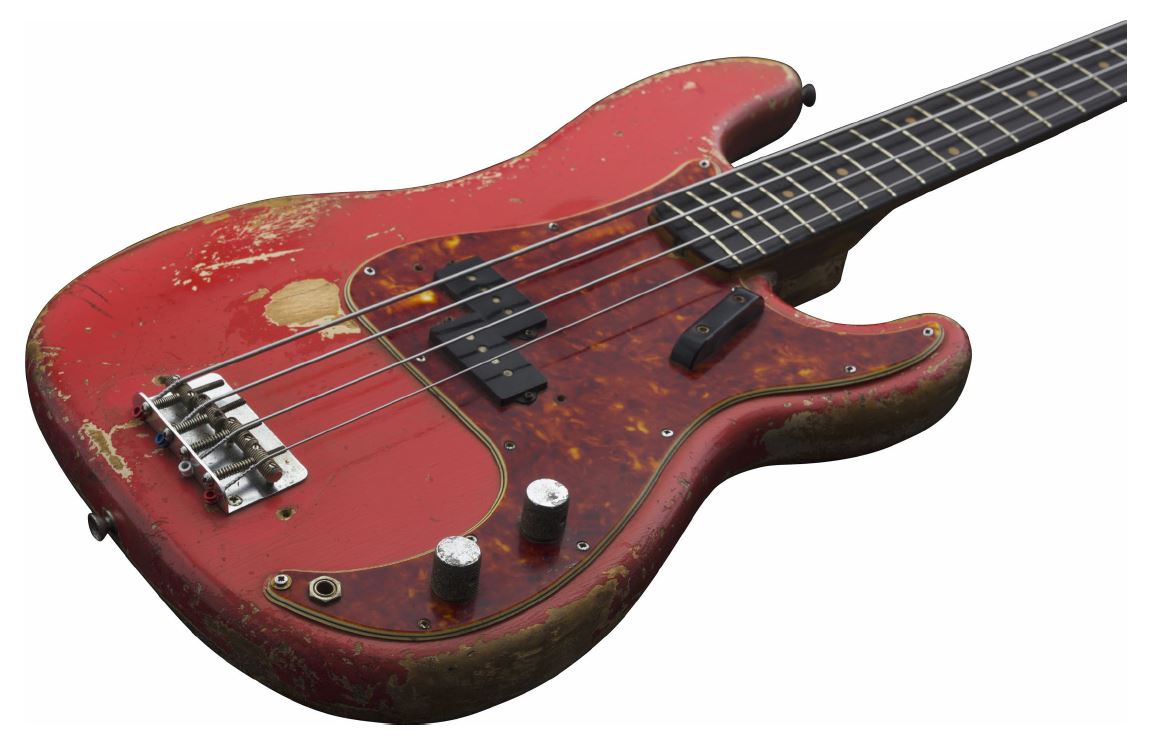
1962
Fender Precision Bass
FIESTA RED
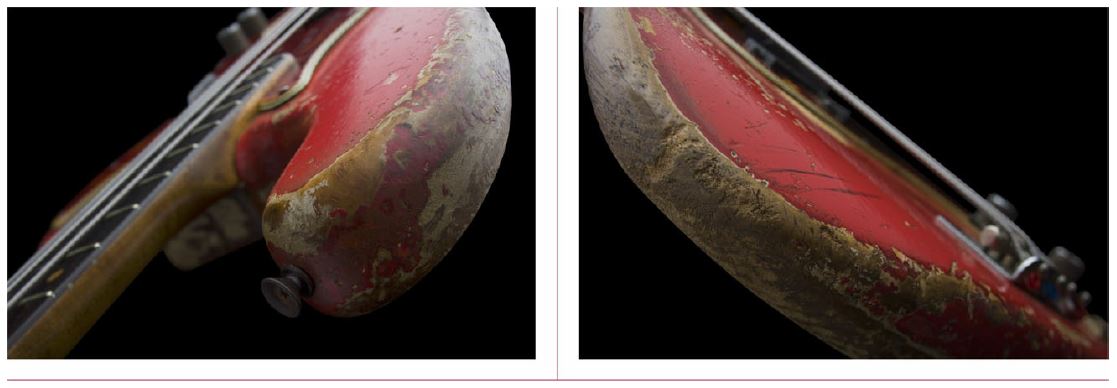
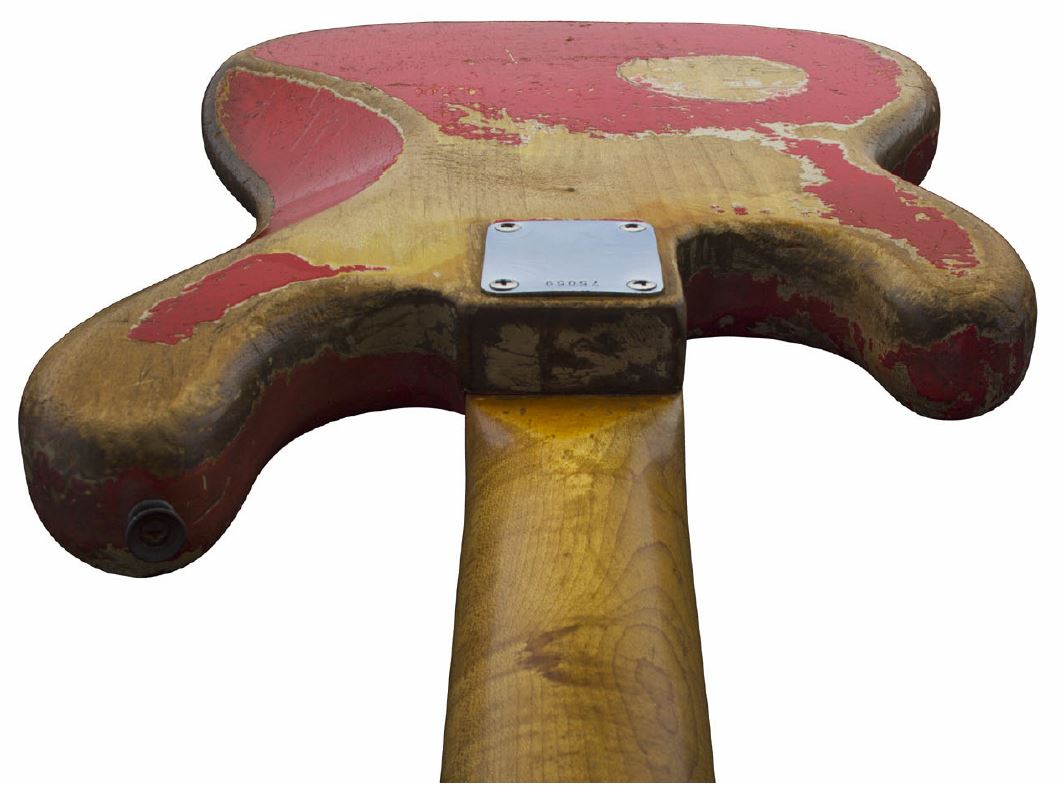
This bass traveled a long way to finally land in my hands. The dealer
purchased it from the original owner in South Africa, and as you can see, it
has lived a life. An honest relic.
The four-layer tortoise celluloid guard appears to still have been standard
on early custom-color instruments prior to late 1962.
1963
Fender Precision Bass
FOAM GREEN
It’s Holy Grail time!
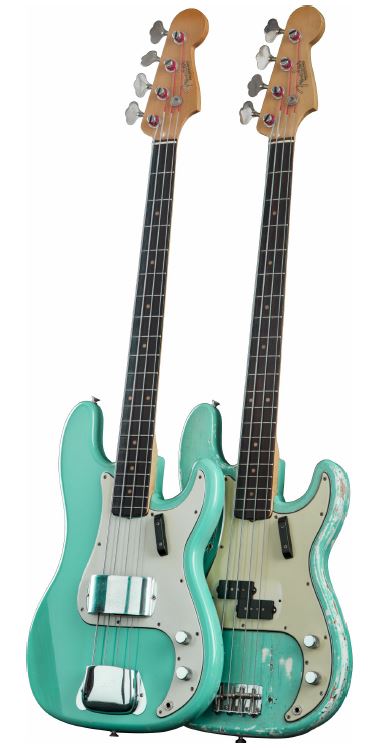
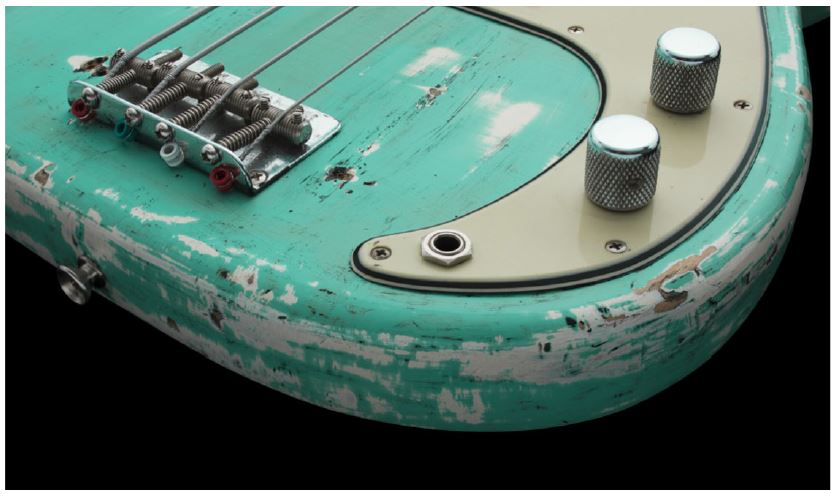
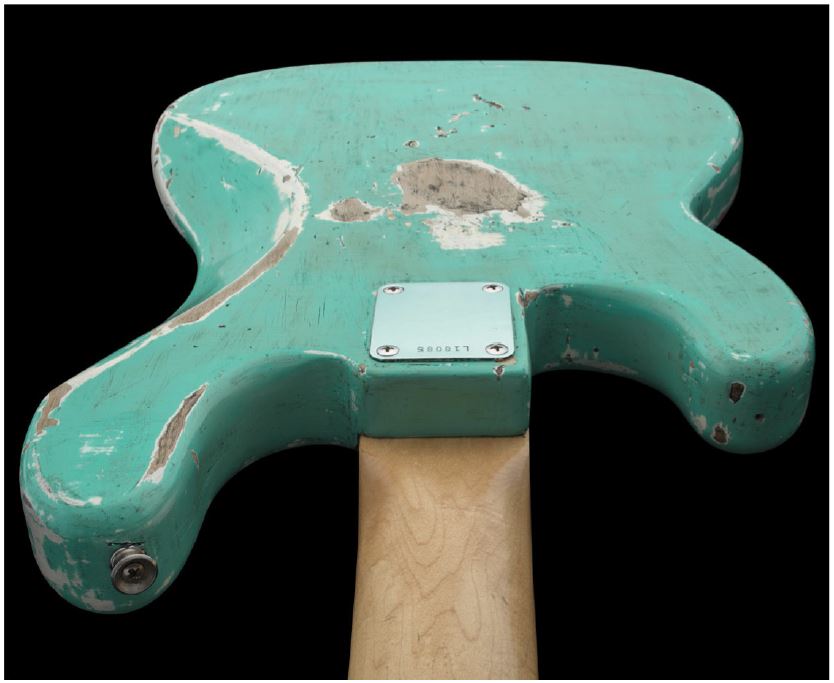
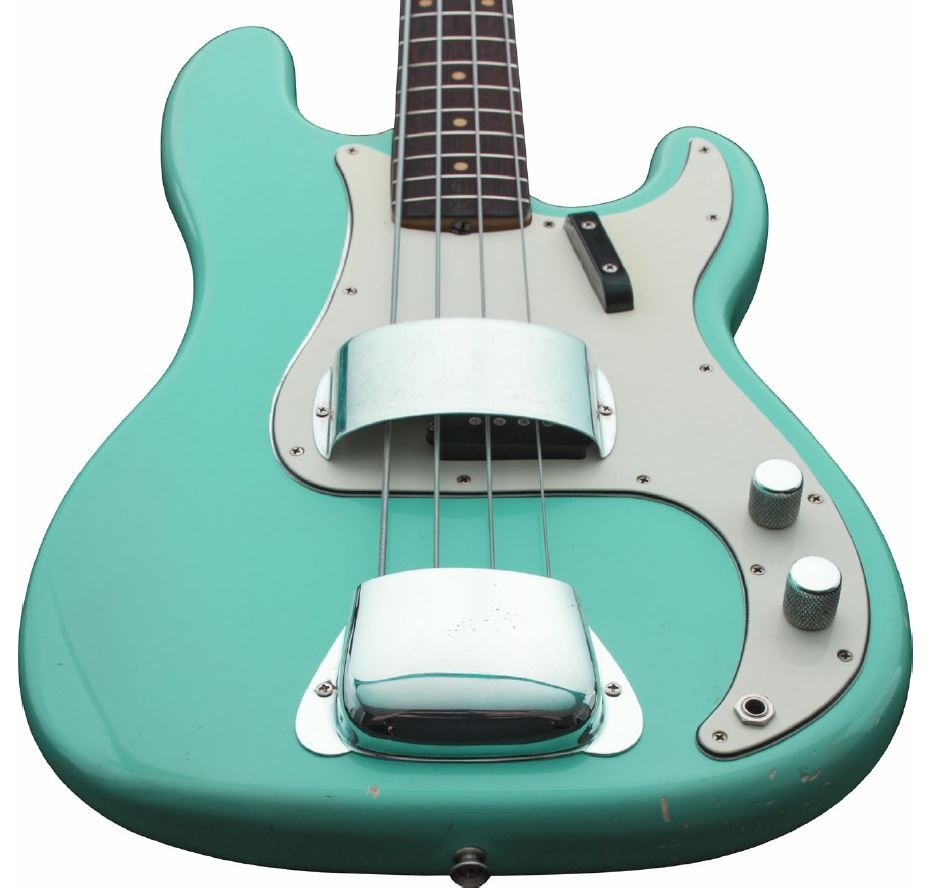
I love Foam Green basses, both because the color’s so cool (visions of California and Chevy Bel Airs) and because they’re really hard to find. It’s the thrill of the chase, you know. One explanation for the color’s scarcity is that it simply wasn’t very popular in the pre-CBS years. As luck would have it, I found these two ’63s within a few weeks of each other, and they couldn’t be more different. The one on the left is clearly a cherished beauty queen. The other, well, it’s been through the wars. Someone decided black was cooler and painted over the green. It’s fortunate that he didn’t do a more professional job, or the original color would have been lost forever. Luckily, someone else was able to remove the black paint. Traces remain, and the buffing has revealed some of the white undercoat, leaving it wounded but, in my view, wearing its history in an authentic and cool way.
As of 1963, the slab board has disappeared, replaced by a thin rosewood veneer.
“I love the simplicity of the Precision. Always sturdy and reliable. It does what it says on the tin!”
—STEVE HARRIS, IRON MAIDEN
1963
Fender Precision Bass
LAKE PLACID BLUE
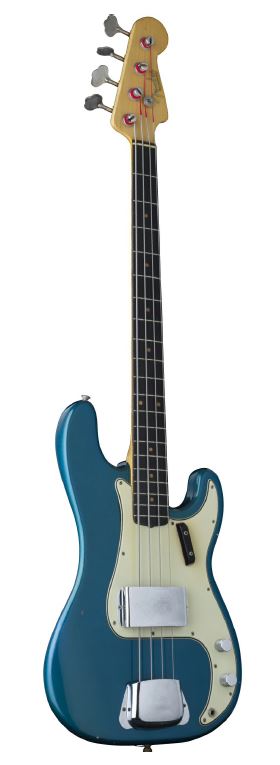
This is the second of two basses that came to me from the renowned collection of veteran bassist Bob Daisley. It’s really nice to find Lake Placid Blue as it was intended to be seen: a deep, metallic blue.
1963
Fender Precision Bass
SONIC BLUE
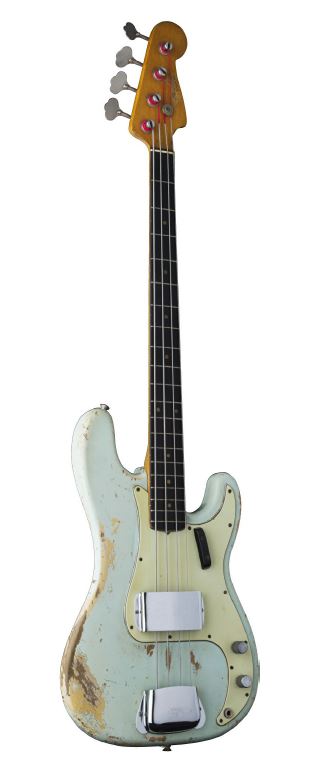
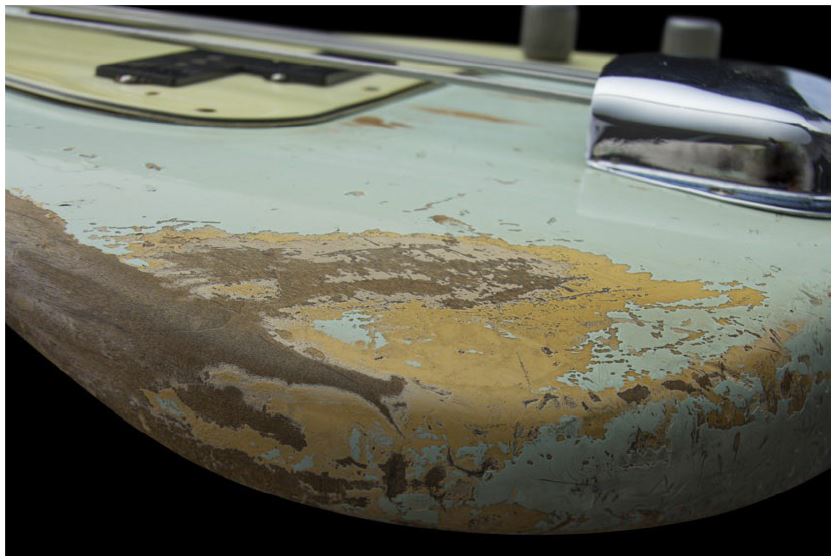
Blood, sweat and tears—the opposite of a “case queen” is a “road warrior.” This bass has earned its title.
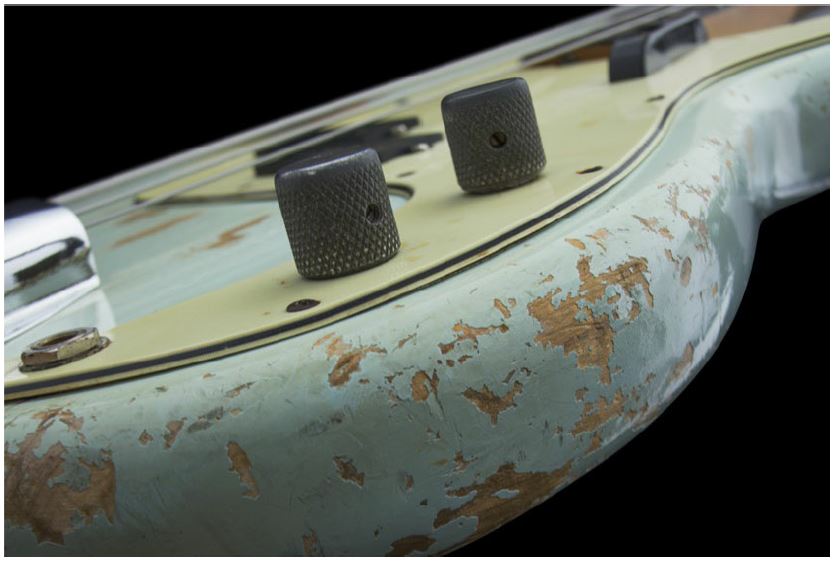
A few years ago, I found myself visiting friends in Japan, and, of course, while I was there I popped into some vintage guitar shops. I made a point of visiting one small place in Tokyo, where I knew there was a rare ’63 Sonic Blue P-Bass for sale. The dealer, a well-traveled guitarist who sold instruments as a sideline, turned out to be a very sweet man. He explained to me that thirtyfive years ago he’d gone to a guitar show in California to buy a bass for his friend, and brought this one back for him. The fellow had played it ever since and, now seventy, had reluctantly decided it was time to retire and let the instrument go to someone else. I could tell the bass had personal resonance for this dealer, due to its history and his friendship with its owner, and that he was not so interested in making a dime on it himself as helping his buddy out. I found the story touching and, after playing the bass in his shop for twenty minutes (and a little good-natured haggling), I knew it was coming home with me. I really enjoyed my time in that little shop tucked away in Shibuya. It was especially nice to hang with a fellow musician from another culture, sharing stories of a mutual passion.
1963 & 1964
Fender Precision Bass
FIESTA RED
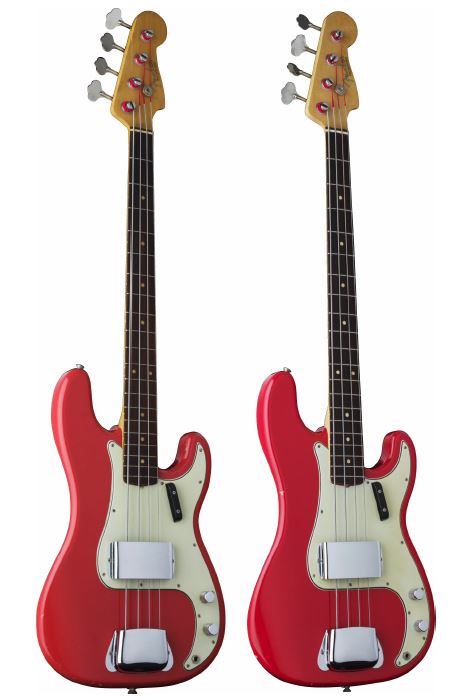
Left to right: ’63 and ’64 mintiness
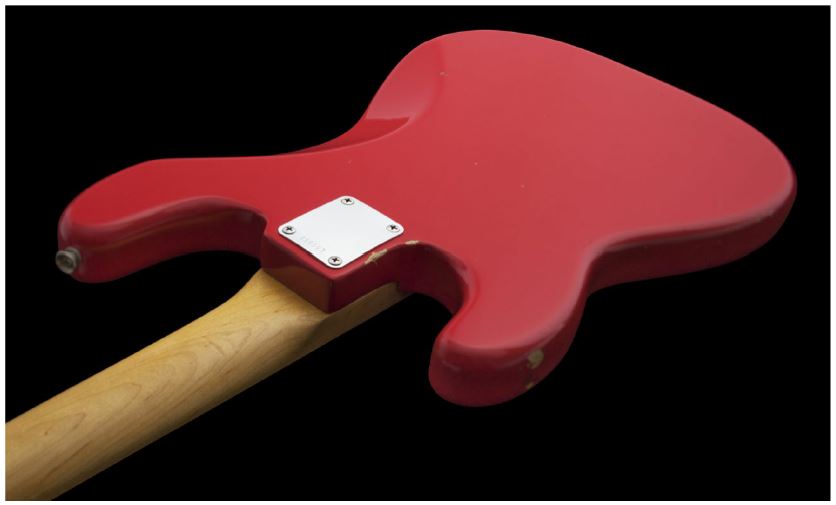
The original owner called the ’63 here “coral pink,” but there is in fact no such color on Fender’s custom color charts; it’s a slightly pinkish version of Fiesta Red.
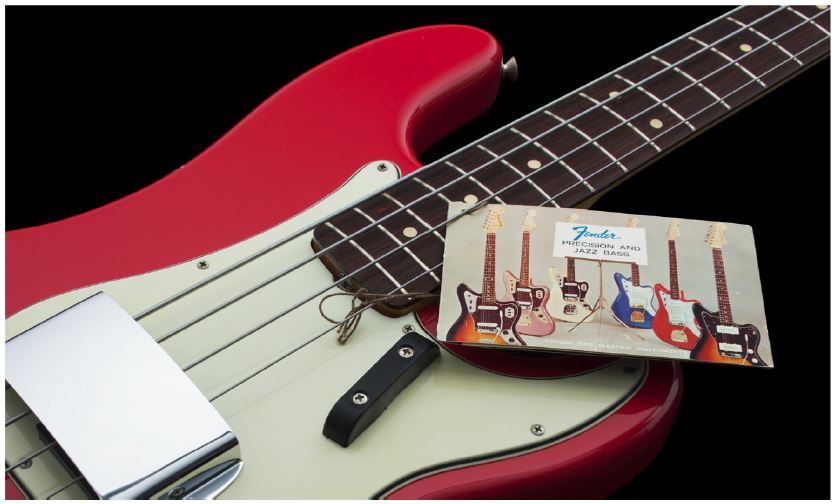
This ’64 arrived with its original hang tag. Aside from its small amount of case wear, it doesn’t suggest to me that it’s ever been properly played. (Well, I’ll take care of that, thank you very much.)
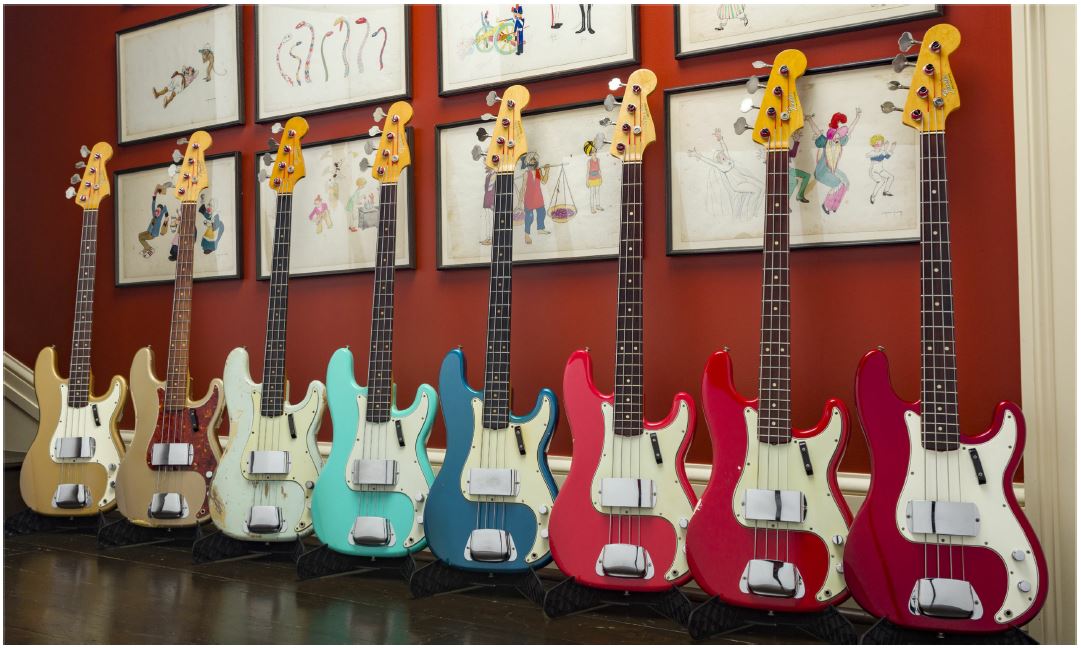
As 1965 approached, it became clear to Don Randall and Leo Fender that they would have to
expand their operation to meet the growing demand. This meant a substantial capital reinvestment.
Leo, who was not in good health at that time, was reluctant and floated the idea of selling his
shares to Don; Don countered with the idea that it was best for the both of them to find a buyer for
the company.
So, on February 5, 1965, CBS bought out Fender for $13 million. To put that sum in
perspective, the company had paid $2 million less to purchase the New York Yankees a year
earlier! The CBS accountants came in, did their assessment, reporting back to HQ that Don
Randall was the brains of the operation and that Leo was not as valuable—retaining him,
nominally, as a consultant. (Wha-a-t? OK, fair enough; they were suits.) Leo signed a noncompete
clause and set up his own workshop nearby, eventually establishing Music Man with his
old colleague and Fender’s first plant manager, Forrest White; and then G&L Guitars with another
ex-Fender man, George Fullerton. So clearly, the takeover didn’t put an end to his tinkering.
As for the Fender corporation, well, this is where it gets controversial. Terry Foster likes to
say, “The Beatles killed the golden age of guitar building in America.” That sounds harsh, but
actually, many of the musicians, collectors, and dealers I’ve spoken to for this book volunteered
the same idea—not just in regard to Fender, but to almost every brand in the US and abroad.
Beatlemania and the British invasion did create an unprecedented demand for guitars that had to
be met. All of a sudden, it seemed like every kid in the world wanted to be in a band, so guitar
manufacturers had to double up on production, and fast. The crux of the controversy surrounding
the CBS takeover and the years that followed it is: What was the impact on quality?
Well, expansion wasn’t happening solely with Fender. As a result of the sudden jump in
production, things began to change incrementally at Gibson, Höfner, and other smaller brands
across the board as well—and I show some of those changes throughout the course of this book.
Although some terrific instruments were produced throughout the 1960s, it’s the guitars and
basses from the early period—due to their craftsmanship and enduring tone quality—that are
increasingly desired by collectors and players the world over.
1964
Fender Precision Bass
BLACK
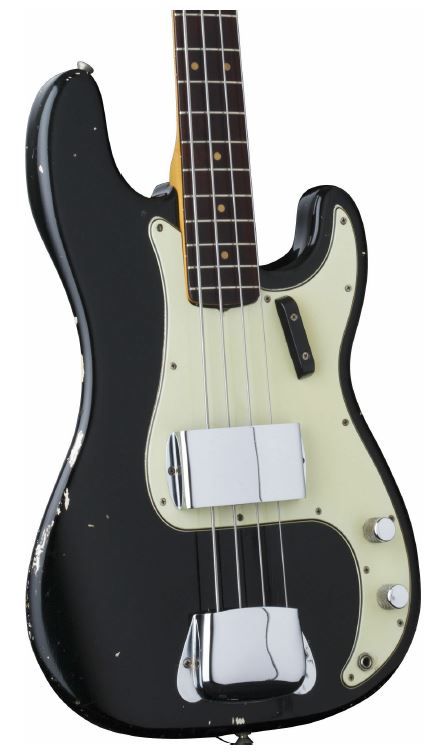
When musicians talk to each other, they usually talk about which of their guitars is a “great player.” What does that mean, exactly? It means that although the instrument may be a little banged up, the neck feels like butter in your hands and the bass just sounds thunderous. This Black P-Bass, which I found in a shop in the UK, is an effin’ great player.
1965
Fender Precision Bass
BURGUNDY MIST METALLIC
(Refin)
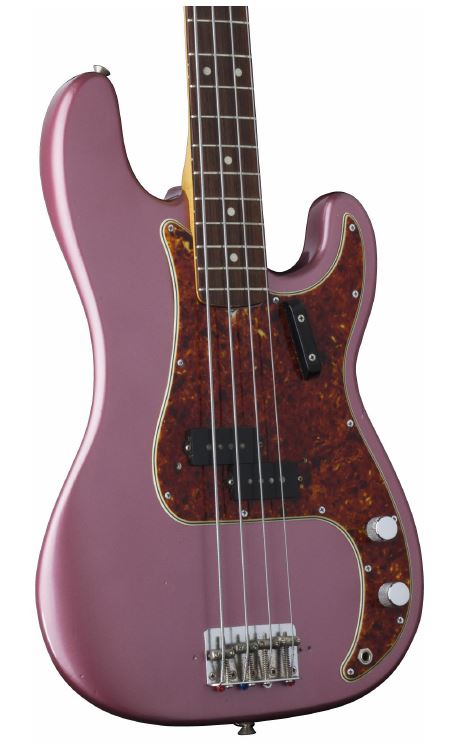
Here’s a bass I got from my first bass tech, Skip Gildersleeve, who sadly passed on in 2013. Years ago it had been stripped to the wood; several parts were changed, and it had sat unused for ages. Then, when I got the vintage bug, I decided to take it out of mothballs and have another look. At the time I owned no Burgundy Mist Metallic basses, so Skully and I sent it to the Fender Custom Shop for refinishing. Turns out, it’s such a terrific-sounding Precision that I used it on the R40 Tour for “Jacob’s Ladder.” How’s that, eh, Skipper?
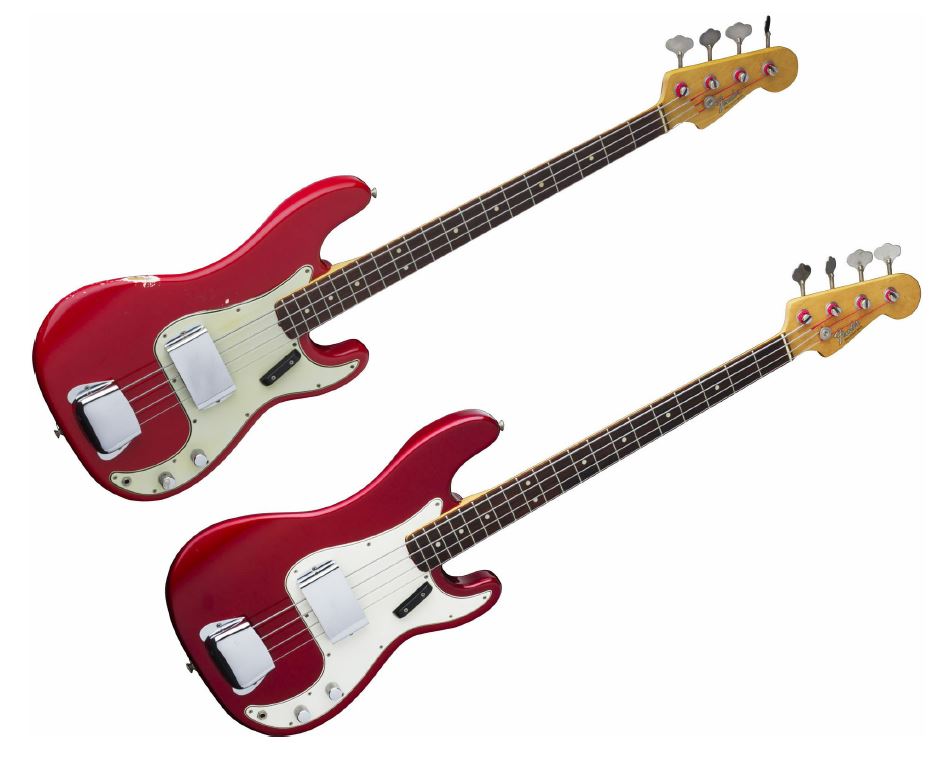
1965
Fender Precision Bass
DAKOTA RED
Here are two 1965 Dakota Red P-Basses. The one on the top is earlier and still shows features from the pre-CBS era; the one below has made the transition to show some new appointments. Gone is the nitro “green” guard, replaced by the white vinyl one, and pearloid dots have replaced clay ones. The “L” serial number neck plate (on the back) is replaced by the “F” plate.
1966
Fender Precision Bass
CANDY APPLE RED
(below, far left)
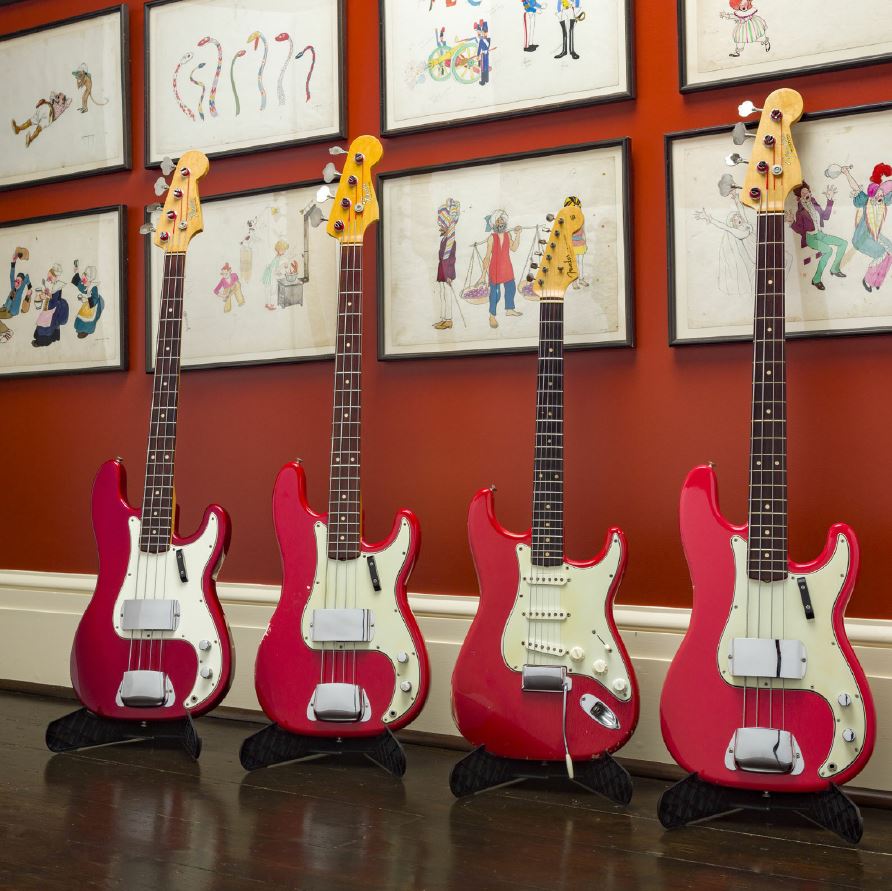
I see red! Pictured to the right of this glorious example of Candy Apple Red are three other Fender custom reds: ’65 Dakota Red Precision, ’59 Roman Red Stratocaster, and ’64 Fiesta Red Precision.
1966
Fender Precision Bass
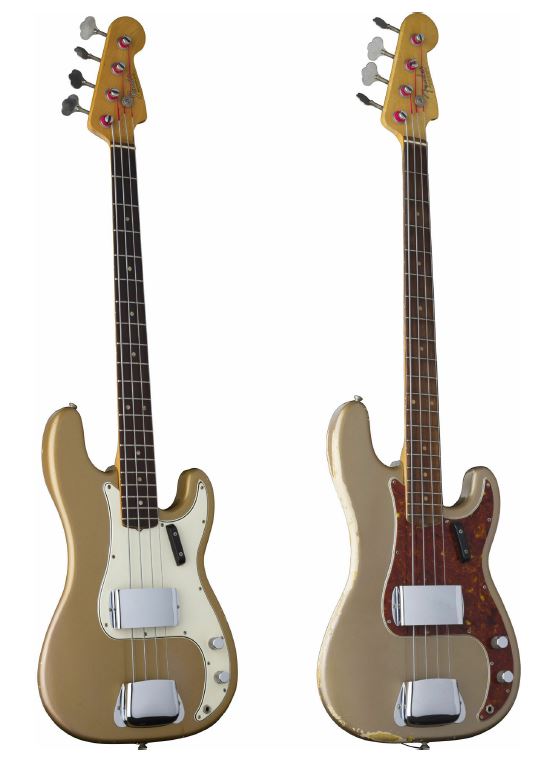
FIREMIST GOLD
This photo shows the difference between two great examples of Fender custom gold colors: a ’66 Firemist on the left and a ’62 Shoreline on the right. Shoreline was only available until 1965.
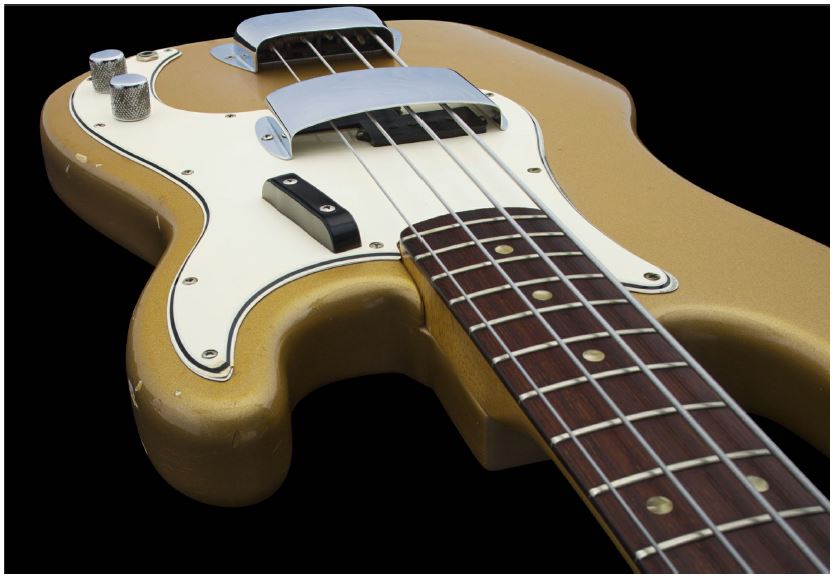
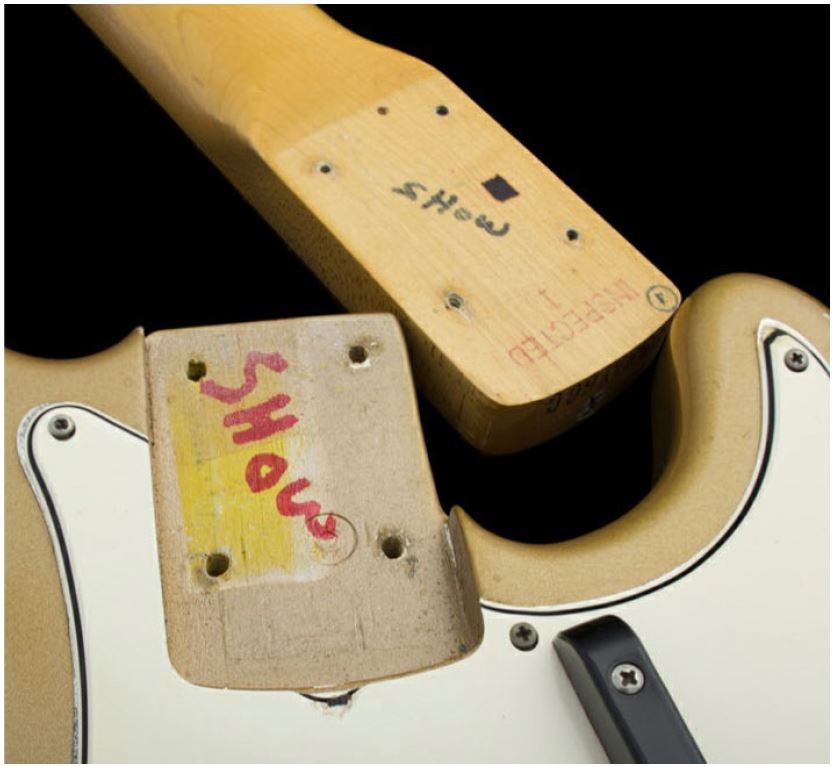
Some instruments are made specifically for trade show events such as NAMM. In order to keep the integrity of the parts together, the shop used various methods to indicate it was a “show” instrument—sometimes stamps, sometimes a mark, on all the relevant pieces, hidden from view.
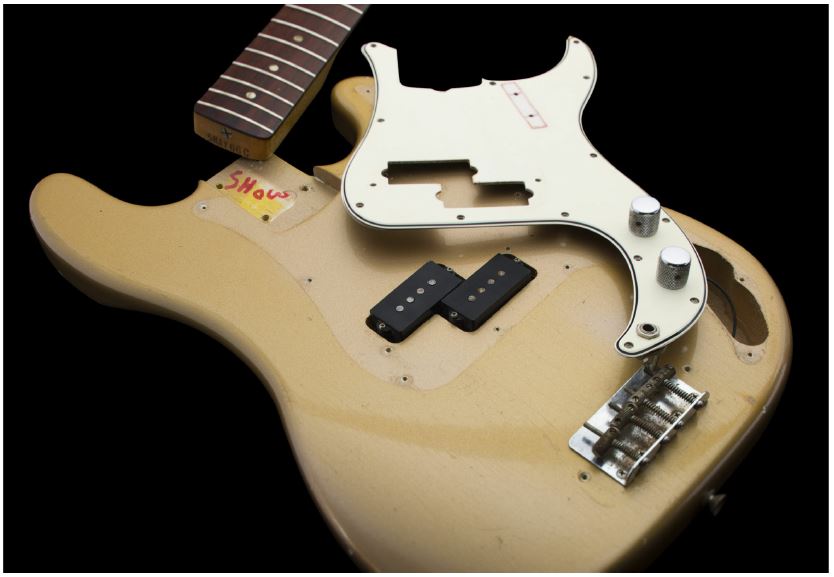
Many collectors won’t touch a mint instrument, and by that I mean they won’t even turn a screw for fear of setting loose a tiny piece of paint or harming the wood. Understandable, but sometimes, when there’s insufficient proof of provenance, you need to verify its authenticity. Musicians, of course, never fear such things, as they usually put their instruments through the wringer anyway. For me, being both a player and a collector, I’ve decided that turning the screw is the only way to go . . . carefully.
1966
Fender Precision Bass
BLONDE
(United Kingdom Reissue)
I was really pleased to find this limited-production P-Bass, an homage to the slab bodies of the early 1950s: a return to that maple neck, headstock style, bridge, knobs, and tug bar, but with a contemporary pickup. I’d seen photographs of John Entwistle, owner of no less than three of them, playing one whose controls he’d modified (and later regretted doing so). “Unlike my other basses,” he once said, “it seemed to roar with a kind of extra ingredient you can’t put your finger on.”
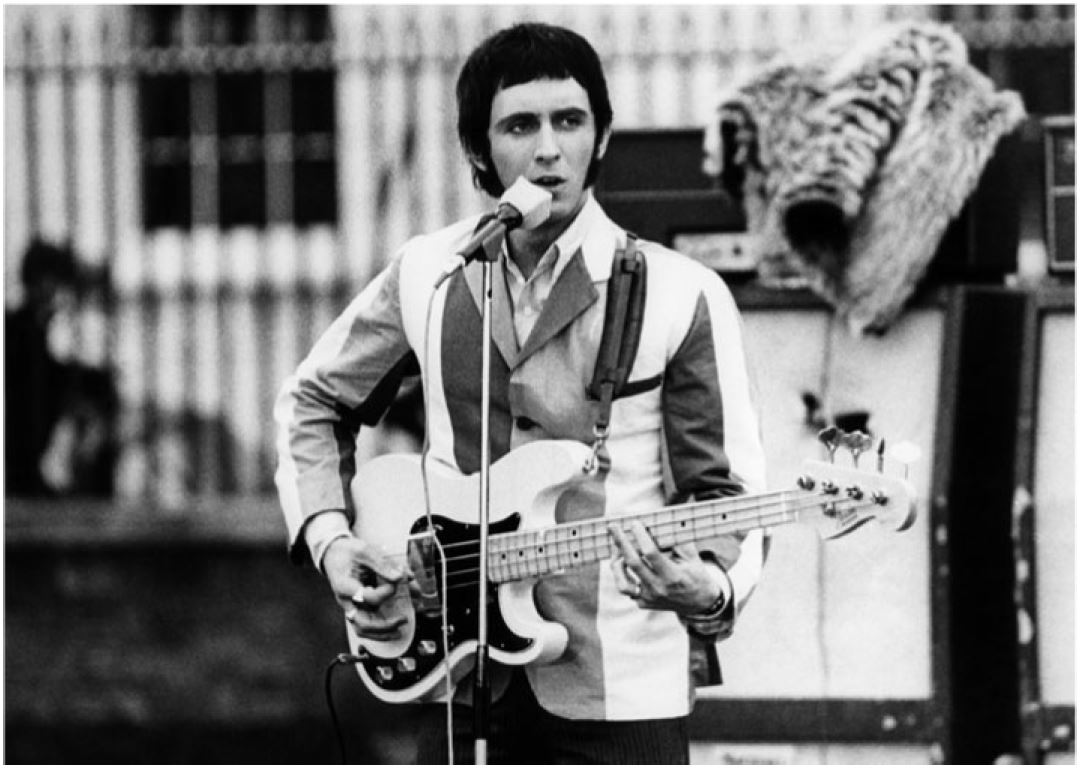
John “the Ox” Entwistle at the Chelsea Barracks with his modified 1966 Precision (Chris Morphet/Getty Images)
According to A Fender Bass for Britain by Barry Matthews, this one is from a batch of only twenty-five made and exported to the UK in 1966 that featured the three-ply black pickguard and maple-capped neck that you see. (A second batch of unknown quantity started production at the end of the year, but had a couple of different features and stayed in the US.)
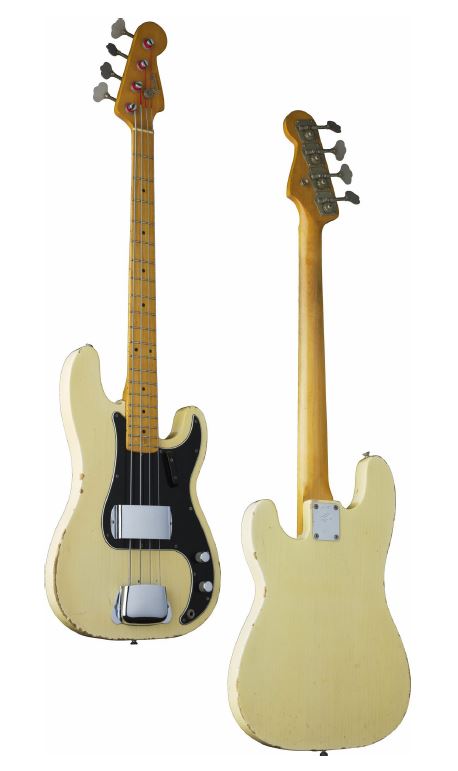
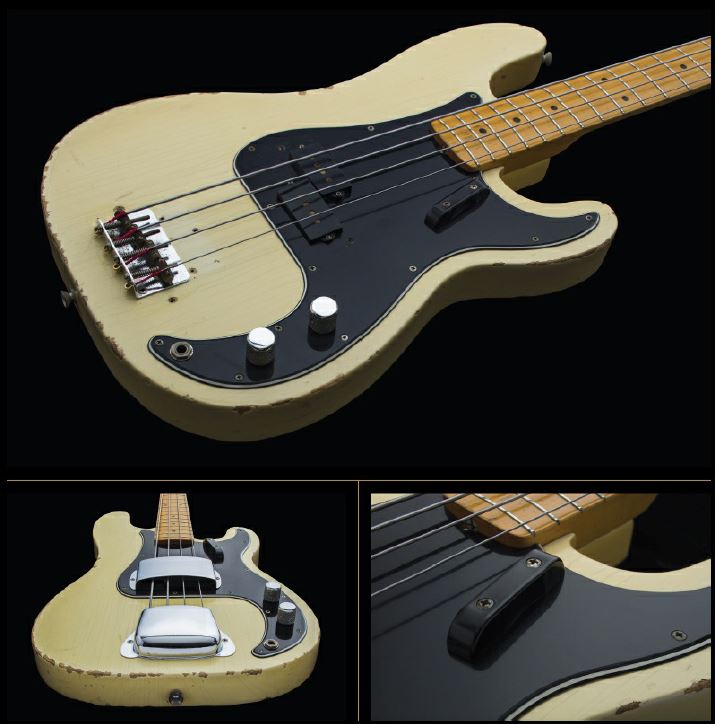
Top and bottom left: The maple fingerboard is briefly revived. Neck construction is two-piece, with the fingerboard separate. Bottom right: The three-ply, black-white-black vinyl pickguard wasn’t used on any other Fender bass.
JEFF TWEEDY
Founding member of Wilco, bassist, guitarist, songwriter, producer, and prolific collector of all things musical
THE LOFT, CHICAGO, OCTOBER 12, 2017
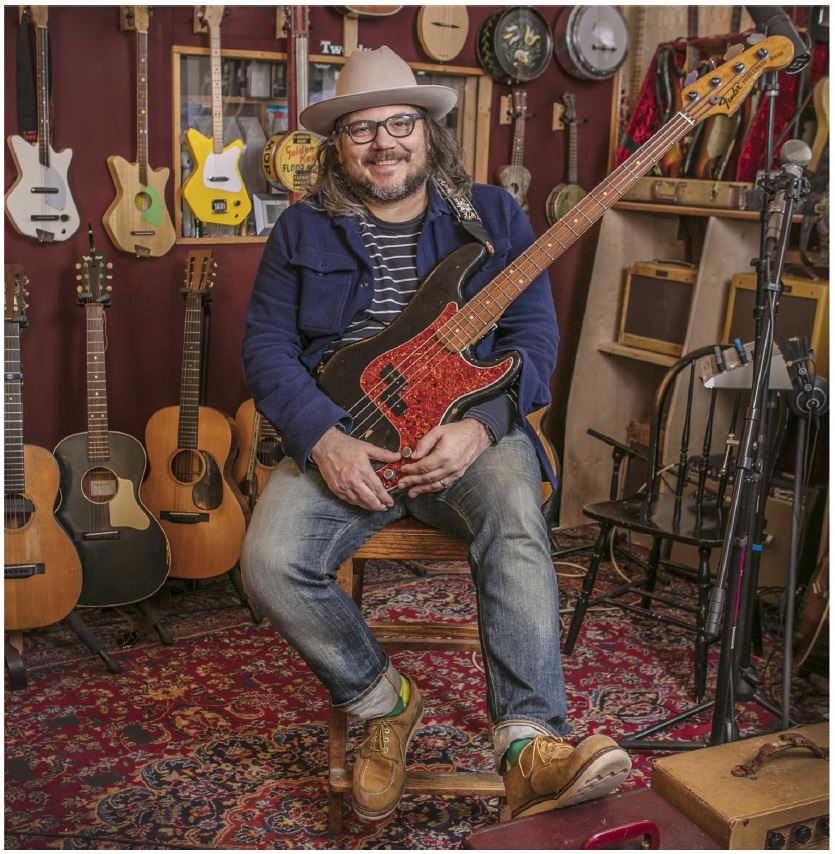
Jeff Tweedy with his main man.
GEDDY LEE: Jeff, tell us where we are?
JEFF TWEEDY: This is the Wilco loft. We’ve been recording up here for about eighteen years. With each record and record deal, I’ve tried to make it more of a fully autonomous studio. Instead of spending money on other people’s studios, I’ve always tried to take a little bit of the budget so we can make our records and not have to watch the clock ticking. It’s not a built-out studio that everybody would desire to record in, but it’s set up for us and always wired and ready to go. I work on something here every day. And it’s a big space, two floors, with lots of room to accumulate more and more gear.
GL: But it’s very cozy. It doesn’t feel like a big space, even though it is.
JT: It’s pretty well curated, I think, at this point!
GL: So, let’s talk a little bit about your early days. Did you grow up in Chicago?
JT: I grew up in southern Illinois, closer to Saint Louis.
GL: And at what age did you first start to notice music in a serious way?
JT: My mother used to say that I would stand and cry and point at the stereo until she put a record on. So I don’t remember there being a time where music wasn’t a consolation for me. I still feel crappy until I find some new music to get me inspired and excited. My brothers and my sister are older than me, so I inherited their record collections when I was very young. I had Beatles and Dylan and Monkees records and all of that stuff, which really wasn’t from my time, but I loved it—more than they did. Then, when my brother came home from college and caught me filling out a Columbia House record club thing, he said, “That’s a scam. Here, you can have my records,” and he gave me a big peach crate full of Amon Düül and Kraftwerk and Aphrodite’s Child and super-weird music that a college kid was listening to at that time.
GL: Any Van der Graaf Generator?
JT: Yep. Atomic Rooster, Hawkwind. . . . So those are the two worlds colliding that, I think, is still somewhat evident in what I do.
GL: At what point did you know that you needed to pick up an instrument?
JT: I asked for guitar lessons when I was about six, and it was a horrible experience—a really hot room upstairs above a department store in downtown Belleville, where I grew up. The teacher wasn’t particularly nice, my fingers hurt, so I threw the guitar in my closet. But I would go to school and say, “I play guitar,” delusional to the point where I would take albums on a cassette that I had recorded and tell people, like, “Born to Run. This is my new record.” I don’t think anybody believed me, but I believed it. It’s delusional, but lying is a form of wishing or something, you know?
GL: It was aspirational!
JT: For sure. Then I had a bicycle accident when I was about twelve that laid me up in my bed over the summer, and I looked over and I saw the guitar and thought, “Well, maybe now’s a good time to learn how to play the guitar, in case somebody actually says—”
GL: Play “Born to Run.”
JT: Exactly! And around that time there were the Ramones and others that were more my speed, that I could connect to faster than the stuff on the radio at the time.
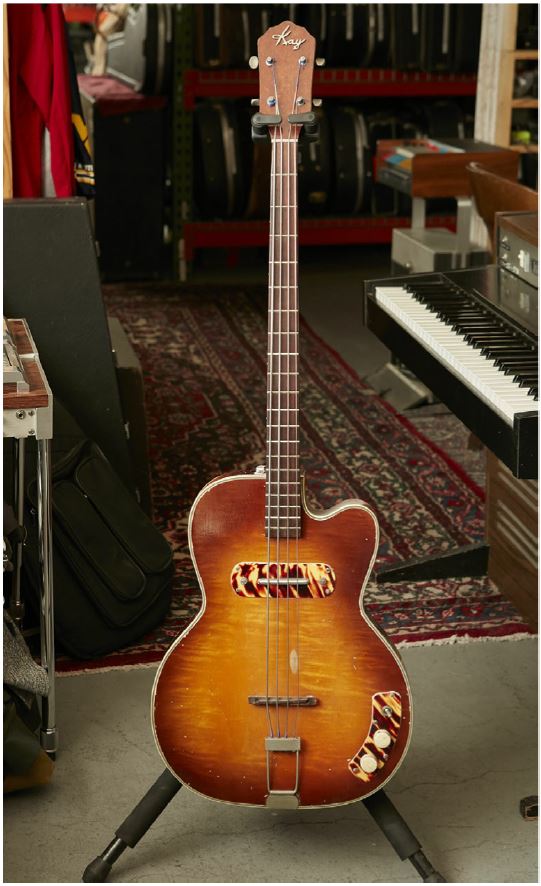
Jeff ’s Kay 162 “Howlin’ Wolf” with the Slim Jim pickup.
GL: So you were a guitarist first. Do you recall the first time you bought what you considered to be a good guitar?
JT: I had a Peavey first, that I traded for a Rickenbacker copy Custom. And it was even worse than the Peavey. Then my brother got a settlement from an accident on the railroad. Everybody in my family worked on the railroad. And he came home with a brand-new Fender Telecaster and gave it to me.
GL: Wow. How old were you?
JT: About fourteen. It wasn’t a good Telecaster, a 1980 or something, but it was the first best instrument I got. I started playing with some friends that ended up being Uncle Tupelo, my first band before Wilco. We were called the Primitives at that time, playing garage covers. Jay Farrar, my partner in that band, was pretty far along compared with me, so I switched to bass. My mom had a cousin who had a band before he went to Vietnam, and who owned a ’63 Jazz Bass, Burgundy Mist, with a B-15 Portaflex Ampeg, that he sold to her because when he came back from Vietnam he said that music had gotten crazy and he didn’t know how to play it anymore.
GL: He had good taste!
JT: Yeah. The most pro rig you can have, right off the bat. It wasn’t loud enough, but the bass itself was really great. It sadly had a pretty tragic death. We were already touring, and the Portaflex blew up, and this guy in St. Louis said he would trade me his amp, a big Seymour Duncan, which was crap, and I was like, “I don’t want to really do this as a permanent trade, but you keep my bass and when I come back we’ll switch back.” And the amp blew up on the road, so I had nothing to give back to him! I was hoping to eventually buy it back from him, but by that time he’d stripped it and made it into a fretless.
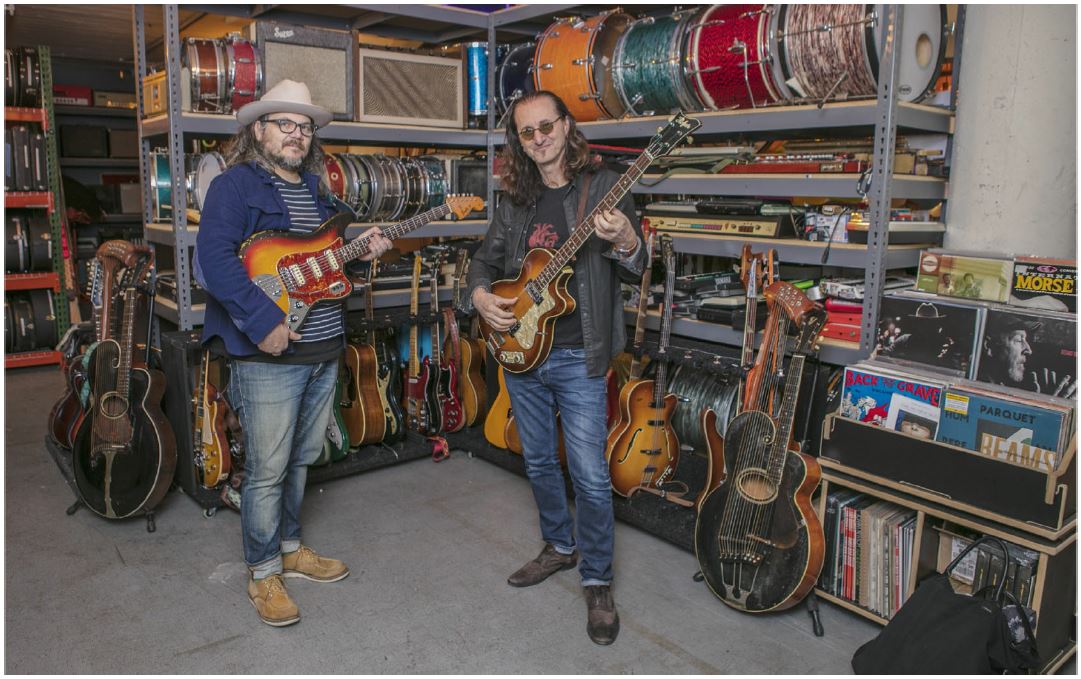
GL: Wow, but quite a story. . . . So, you had become a bass player, and your first bass was a Jazz Bass?
JT: Uh-huh. And shortly after that I was working in a tiny local music store, and somebody walked in with a P-Bass that he wanted to sell or trade in, and the owner of the store wasn’t interested in it at all, because it was like a ’68 neck on a ’73 body, and Eddie Van Halen tape on it, but I said, “I’ll give you a hundred and fifty bucks for it,” and the guy sold it to me. That’s the main bass that I still play all the time. It’s got an “A” style PBass neck, which is really hard to find—more like a Jazz neck. I’ve always loved P-Basses, but I’ve never been able to find a really good vintage one that has all of the same qualities as that bass. It’s not an aggressive bass, it’s like a thumpy soul bass, a country bass.
GL: Well, yeah, you can twang ’em up or put some flatwounds on ’em! So, at that time in your life, transitioning to be a bass player, were you listening to songs in a different way, focusing on the bass parts?
JT: Occasionally I would see someone play that would inspire me, but my main orientation has always been to just make stuff up. I’ve not been a disciplined learner of scales or of other people’s technique or anything like that. If I can hear it in my head I strive towards it, and as I learn I get better. So, after thirtysomething years, I’m starting to be able to play stuff off other people’s records. It’s always been a desire to make something that’s fresh to my ears, even if it’s not necessarily fresh. I remember the first time I learned the rock ’n’ roll riff, and I really, honestly, I’m so delusional, I thought I invented that! Like, “This is great. This is going to be huge! People are going to love this.”
GL: [Laughs] That’s fantastic!
JT: But to answer the question, I would see, like, a band like the Minutemen, with Mike Watt, who had a fantastic, unique voice as a bass player, and I’d go home and appropriate a little bit of that into what I did. But it would never be sustained or studious.
GL: So basses were just one more creative tool for you.
JT: Correct.
GL: Do you write songs on your bass?
JT: I just wrote a whole record for Mavis Staples, and I started with bass on most of those tracks. I got out the Rhythm King drum machine that’s on all the Sly and the Family Stone records, and it was really inspiring to get in the headspace of those records. And I started with bass lines on a lot of it. I write on acoustic guitar predominantly, but there’s always something to work on up here if I’m not particularly inspired. I feel like you don’t write if you don’t pick up the pencil. To keep it exciting for myself, I’ll look up a new tuning, then start grabbing things and have no idea where I’m going. You always end up having like a little a-ha moment and having a bunch of songs.
GL: Alex [Lifeson] is exactly the same way. He loves and invents odd tunings. It does make you think differently, or stops you thinking too much. Do you find that the search for that spark is connected to the acquisition of some of these instruments?
JT: Collecting for me is not of just instruments but of sounds. I scour the internet, and I’ll just become fixated on something. I see myself holding it and something good happening. A lot of times things come here and don’t actually get picked up right away, but every once in a while I’ll stroll around and find something I bought five years ago, and it becomes the basis of a track. It’s a pretty bad business model, in a way!
GL: It’s a passion you have to follow. We rationalize it by saying it’s probably a good investment. “It’s deductible, honey!” So, do you consider yourself a collector?
JT: Well, I obviously am a collector, but I’m not obsessive like people who want to have every custom color of every Fender Stratocaster from every year. It’s much more haphazard, like I’ll watch a YouTube video of Link Wray and go, “What the hell guitar is that? I want one of those!” To be honest, the things that I don’t play, even the things that are valuable and I know are good investments, I don’t love them. And I’m tempted to get rid of them a lot of times. The only reason I don’t is because I know if I ever wanted one again it would probably end up costing twice what I paid for it.
GL: I follow your Instagram account, Fonts of the Loft, and you seem very design aware—the logos and the patina, which is right up my alley, too. How did that idea come along?
JT: It’s actually mostly Mark Greenberg, our studio manager. We all talk about this stuff, but he took the initiative to share it with people. The original patina thing is really interesting because so many manufacturers make relic’d guitars. But there’s nothing compared to. . . . Like, I have a Trini Lopez that somebody carved an Indian head into, and it’s the coolest-looking thing ever, you know? Nobody’s ever going to do that at a custom shop. Once, I bought a 1950s J-200, a Gibson acoustic, and inside there was really yellowed Scotch tape that was falling off with a phone number. It said, “Bob.” So we called, thinking surely Bob’s dead, but no. He was part of an Ernest Tubb Western show in Nashville, and had a couple of 45s out in the 1950s and 1960s. He sent us a picture!
GL: Now that’s real provenance.
JT: Actually, I have two J-200s from roughly the same period, both with double pickguards, and one says “Bob” and one says “Buck.” Like, hey! I can’t believe I found both those guitars!
GL: When you’re looking for an instrument, what kind of things do you find visually irresistible?
JT: Just a crazy design. Like the 1960s and 1970s, when many guitars were designed with this notion of the good old future, when everything was kind of forward leaning. We were entering this space age, and people wanted instruments to say something about our modernity. Not to get too philosophical, but there’s something really hopeful about those instruments to me. Even when they’re Japanese, maybe even especially some of the old Japanese stuff, even though they’re hardly ever playable. Everything in our culture is much more fragmented now. There’s little tribes of different thought, and people maybe have to have a degree in design to understand what the references are. Industrial design now to me seems to be reflecting a desire to hang on to what we have. People are fearful and want to feel secure. In that period, I’m sure there was no lack of fear, with the atomic weapons and things like that still fresh in everyone’s memory, but there was much more of an overall design momentum towards a better future.
GL: Good old-fashioned American optimism! Like the T-Bird Bass, a positive look at the future.
JT: Recently I’ve been getting into Czechoslovakian and Soviet bloc guitars, and it’s interesting—they don’t quite get it. They’re like, “I like the future, but it still should look like a balalaika.”
GL: [In a Russian accent] “With large iron knobs.”
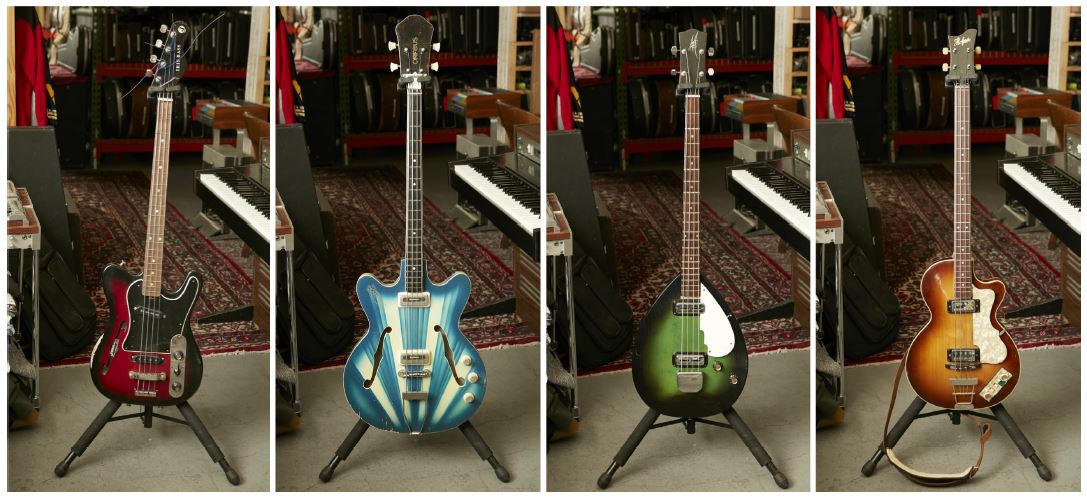
Left to right: Jolana Iris bass—Jeff says, “These are terrible basses from Czechoslovakia, but they have a really incredible low end. One of my favorite features is built into the strap pin [opens panel] . . . a flathead screwdriver!”; Orfeus Hebros bass—“First time I set down this 1960s Soviet Bulgaria-made bass, it just went shunk.”
(Note the misspelling of “Orpheus.”); Maton Teardrop—“This is not a good lap guitar”; the Höfner Club Bass that Wilco’s bassist, John Stirratt, has been using for years.
First and foremost, I would like to thank my incredibly tolerant family, for
putting up with yet another of my obsessions—with its subsequent absences,
physical, mental, and social.
And, of course, my team: John “Skully” McIntosh, for his curating and
steadfast dedication to the instruments; Daniel Richler, who wrestled words
with me for many months to help me express myself with precision; and, of
course, Richard Sibbald not only for his truly stunning photography but also
for his constant optimism—they all made contributions truly above and
beyond any reasonable expectation. This book would not exist without their
efforts.
I’m also much indebted to . . .
The members of our round table: Colin Cripps, Terry Foster, John
Minutaglio, and Clem Coloum, for their immeasurable help in bringing us up
to speed on all things great and small in the world of vintage instruments, not
to mention our knowledgeable interviewees for making themselves available
and even allowing us to invade their homes: Les Claypool and Cheney;
Adam Clayton and Marianna; Ken Collins; Bob and Vicky Daisley; John
Paul Jones; Alan Rogan; Robert Trujillo and Chloé; Jeff Tweedy and Mark
Greenberg and the guys of the Loft; and Bill Wyman.
Signe Bergstrom, Lynne Yeamans, Cristina Garces, and Marta Schooler
at Harper Design, for working so effin’ hard to make this book so truly big
and beautiful; Ron Eckel of the CookeMcDermid Agency, for his tremendous
support behind the scenes from before the beginning and right throughout the
project; Paul Kepple, for his detailed design work and for sharing his wealth
of experience with a newbie like myself; Norma Toraya, a.k.a. Crankbunny,
for enlivening this book with her immense creative wackiness; Patrick
McLoughlin, for helping put it all together in a big and beautiful package;
Pegi Cecconi, Cynthia Barry, Veronica Sinnaeve, and Sheila Posner, for their
executive and organizational prowess; Ray Danniels, ’cause he’s my
manager; David Steinberg, for legal wrangling (and for being a helluva
drummer); Andy Curran and Allan Weinrib, for all kinds of help and support;
Zilla Parker and Neal Zeagman, for helping to shuttle people and basses; Neil
Warnock and Samantha Henfrey at United Talent; Stuart Morgan and
Natasha Isaacs, for their help arranging the UK-side interviews; Brian and
Stephanie Fisher, not only for their kind and generous hospitality, but also for
sharing their love of collecting with me; and Lisa S. Johnson, whose luscious
book, 108 Rock Star Guitars, was such an inspiration.
I would also like to thank Mike Bump, Billy Siegel, and the rest of the
good people at Fender and the Custom Shop, for their abundant
contributions; Stephen Stern and Ron Thorn at the Gretsch Custom Shop;
Clive Brown, for sharing his eagle eyes and advice; Keith Smart of the
Zemaitis Owners Club, for his factual contributions and personal photos;
Martin Kelly and Brian F. Wright, for helping with historical background;
Bruce Johnson, for keeping the Ampeg flame alight; Tom Brantley, for his
ever-reliable pickup expertise; Danny O’Brien and Tim Harrington, for their
engraving skills; Judith Klassen and the good and helpful people at the
Canadian Museum of History/Musée Canadien de l’Histoire; Cosmo and
Jason Sniderman, Rick Gould, Joe B., Ron O’Keefe, Kevin Fullbrooke, Dave
Pascoe, and Chris Clayton, for all sorts of help, Albert Molinaro (co-author of
the incredibly useful book The Fender Bass: An Illustrated History) for
sharing his knowledge and insight; and all the great dealers across the globe
too numerous to mention, for keeping a sharp lookout and feeding my habit.
Last but most certainly not least, my partners for over forty years, Alex
and Neil, whose friendship, encouragement, and creative spirit remain a
touchstone in all of my endeavors.
GEDDY LEE is a remarkably youthful bass player, born in 1953. For more than forty-two years he’s been a member of the Canadian hard rock trio Rush who, after numerous self-indulgent recordings and about a bajillion concerts, were mercifully inducted into the Rock and Roll Hall of Fame in 2013. Geddy is an Officer of the Order of Canada, holds an honorary doctorate in music from Nipissing University, and, along with his bandmates, was named “Musicians of the Millennium” by the Harvard Lampoon, yet he is most highly regarded for having won his fantasy baseball league four seasons in a row. He has also fathered two reasonably intelligent children and lives near a remote village in the Great White North in a home surrounded by land mines with his lovely wife, Nancy Young; two small but extremely dangerous Norwich Terriers; and far too many bass guitars.
GEDDY LEE’S BIG BEAUTIFUL BOOK OF BASS. Copyright © 2018 by Dirk Music Inc. All rights reserved under International and Pan-American Copyright Conventions. By payment of the required fees, you have been granted the nonexclusive, nontransferable right to access and read the text of this ebook on-screen. No part of this text may be reproduced, transmitted, downloaded, decompiled, reverseengineered, or stored in or introduced into any information storage and retrieval system, in any form or by any means, whether electronic or mechanical, now known or hereafter invented, without the express written permission of HarperCollins e-books.
Published in 2018 by
Harper Design
An Imprint of HarperCollinsPublishers
195 Broadway, New York, NY 10007
Tel: (212) 207-7000
Fax: (855) 746-6023
[email protected]
www.hc.com
Distributed throughout the world by HarperCollinsPublishers
195 Broadway, New York, NY 10007
Fender, Fender in script, Bassman, Jazz Bass, Precision Bass, and the distinctive headstock commonly found on Fender guitars and basses are registered trademarks of Fender Musical Instruments Corporation and used herein with express written permission. All rights reserved.
All photographs by Richard Sibbald unless otherwise noted. www.richardsibbald.com
Chapter title spread photo concepts: Daniel Richler
Every effort has been made to provide credit information for third-party images. Any error will be corrected in subsequent reprints.
Library of Congress Cataloging-in-Publication Data has been applied for.
Digital Edition DECEMBER 2018 ISBN: 978-0-06-274784-6
Version 11272018
Print ISBN: 978-0-06-274783-9

Geddy Lee's Big Beautiful Book of Bass